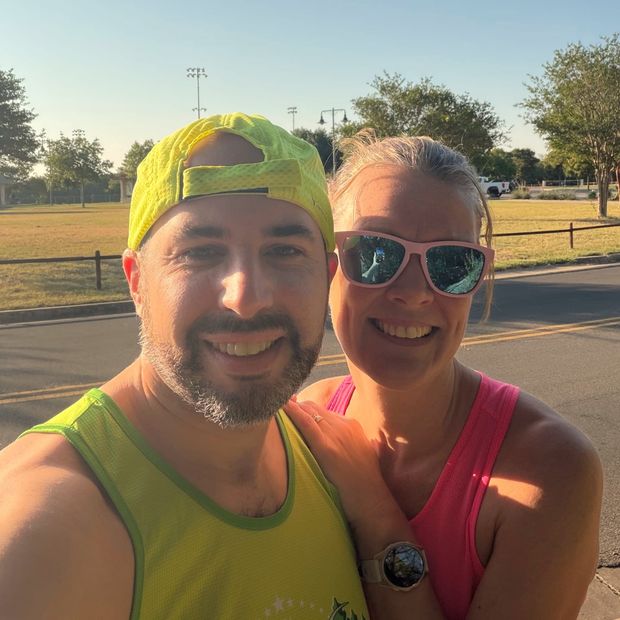
In this episode, Abbie and I kick off a new podcast season by discussing the husband-wife fitness dynamic. Is it possible that couples who workout together have better relationships?
We share a few tips that have helped us reach our fitness goals together, and talk about things that might not be so helpful, too. And because it's Practically Fit, we also shared insightful evidence that couples’ fitness routines just might be the secret sauce for a healthy relationship.
We hope you’ll enjoy this new format for the podcast. If you’ve got a comment or question, please let us know via the comments below or shoot me an email at alex@practically.fit. We’d love to share your comment or question on the next episode of the podcast. And always, please leave us a review on your favorite audio platform.
Read The Transcript
Alex: Welcome to season two of Practically Fit, Real Fitness Over 40. I'm Alex.
Abbie: And I'm Abbie.
Alex: And today we're going to talk about the husband-wife fitness dynamic. For those of you who are familiar with the podcast, you may be wondering, "Where have you been?" Or, "What am I missing?" Or maybe an even more fundamental question: "What is this podcast about?" Before we jump into this week's episode, let's do a proper season-opener intro and recap where this podcast has been, and where it's going. In season one, I hosted the show with my good friend Jen. At some point we just got really busy with our lives — jobs and things like that — so we put the podcast on hiatus, and that continued up until now. Abbie and I had been talking about it, and thought, man, we'd really like to restart Practically Fit. So we're moving forward with the show, with Abbie and me as co-hosts. It's going to be fun to co-host a show with my wife. Jen is going to try to join us down the road when she can — that's how we're doing the podcast moving forward. We'll be taking the same pragmatic approach to exploring fitness over 40 that we did in the first season — sharing everyday fitness stories, looking at trends, debunking myths, and comparing our experiences to fitness culture, all with the aim of providing real, practical fitness ideas you can fit into your everyday life. So that's what's new this season — I'll be co-hosting with Abbie, my lovely wife, and we'll be talking a lot about our own fitness experiences. Fitness is a really big part of our lives, isn't it, Abbie?
How We Met
Abbie: Yeah, absolutely. And that's why, for the first episode, it felt really natural to talk about how to experience fitness as a couple. I was actually a guest host on one episode of season one, where we talked about whether romantic partners can make good fitness friends, and whether working out with your significant other is a good idea. We've linked that episode in the show notes, so feel free to go listen. But spoiler alert — the answer was yes. Because for us, it really has been a big part of our overall story. Alex and I came together during the pandemic — that's when we first met. And for those who remember the pandemic, which is crazily six years ago now, it wasn't really a time to go to restaurants or bars. So we met really being outside.
Alex: That's right. Our first date was on a hike at the local nature preserve, if I recall. I think we probably talked about that in the podcast episode that's linked in the notes. But that's really — I think we even met on Bumble, and I remember chatting with you, and your profile said something about cycling.
Abbie: You mean — I had a couple of moody pictures of him out on hikes, looking across lakes.
Alex: That's right — I was mysterious. But hey, it worked. I think, if I recall, you messaged me and said you had three bikes, and I thought, wow, we went in strong with, "I have three bikes."
Abbie: But, you know, things have changed for us over the last six years. Fitness is still a really, really important part of our lives — it's something we actively prioritize. But some of the things we do have changed since we first got together. We still really like to work out, and we like to work out at the same time, but sometimes we do different things. That's actually become even more of our dynamic, I'd say, since we've shifted a bit away from cycling — which is what we did a lot of when we first met — and toward running, because we run really different paces, and we also trend toward different racing goals. Alex loves speed, and he loves a 5K. I hate 5Ks. I do them —
Alex: You do them, yeah. We did one a few weeks ago and you did really well.
Abbie: Yeah, I just find the first two miles of a run hard work, so I tend to prefer more mid-range distances — the half marathon is my favorite.
Alex: Oh — I think I just figured out why you don't like 5Ks. It just hit me: if you find the first two miles hard work, well, the third mile of a 5K is a beatdown.
Abbie: That's exactly it. Normally that's the two miles — if I'm doing a half marathon, that part sucks, but then you get into your rhythm and can hold that pace. Whereas in a 5K, you need to kick it up in the third mile.
Alex: Yeah — or try to, unlike the one we did a few weeks ago. So I think we'll do a future episode with me, Abbie, and Jen where we each argue for our favorite race distance — Jen will come in to champion the marathon, I'm sure, Abbie will do the half marathon, and I'll do the 5K. But getting back to this dynamic of working out at the same time, even doing the same activity — in this case running, since that's something we do together sometimes — it's interesting how our dynamic has changed over the years. Abbie mentioned cycling — for cycling, we'd just go out and ride together. When we first met, you were in really good cycling shape, to the point where some days I'd have trouble keeping up with you, and other days you'd have trouble keeping up with me, depending on the day and our fitness levels. But now, with running, as you mentioned, we do different paces. So it's the same activity, but sometimes we do it separately. I think one thing we've discovered is that's really the best of both worlds, because we're keeping each other accountable and spending quality time together — we can celebrate each other's achievements, but also do things at our own pace. That's really been working for us. I think there are a few lessons we've learned from our husband-wife fitness dynamic.
Shared Schedules
Alex: The first thing I thought we could throw out there is just having a plan or schedule that's shared.
Abbie: Yeah, I think that's really important, especially when you're a couple living your life together — you've got other commitments, whether that's kids or dogs or whatever, and we have both of those. So you have to fit fitness into the schedule of your life. I think it's about being able to tell each other what's a priority. Earlier this year I was training for distance, so I needed to do a long run on the weekend — I needed to fit that into my timeline, and Alex knowing that, and knowing which day I was targeting for it, meant we could balance it with everything else we needed to do.
Alex: Yeah, and I'd do my version of a long run on that same day — not 10 miles, maybe four or five — but we kept the schedule shared. Lately we've been doing this run streak thing, so as of today we're on day 49. Sharing a schedule when you're running every day isn't that difficult. But yesterday's a great example — we're in Texas, it's hot, and I've been getting up at 5:30 most mornings to run, especially during the week, before work, since I go into an office. Abbie works from home for the most part, so it's a little frustrating for her, I think, sometimes, when I'm getting up at 5:30 — she'll get up, probably around seven, and go do her run before work.
Abbie: Yeah, and Alex is very good at being quiet — he's got all his stuff prepped, he's out the door, and I'm able to go back to sleep.
Alex: Yeah, that's what we'd do most days during the week, but some days we don't feel like getting up early. It's hot here, so in the summer, if you're not running first thing in the morning, it's really challenging — even in the evening, it can be tough with this kind of heat, and even if it's 6 p.m. and the sun's still pretty high, it's still a bit of a beatdown. But yesterday was a great example — it was Saturday, we wanted to sleep in, so we didn't get up at 5:30 or 6:30. We slept in, and then went to the gym, and we both ran. Abbie likes to run on the treadmill at the gym; I like the indoor track.
Abbie: Although he looks like a little hamster, going round and round.
Alex: I'd say I like it — it's preferable to me than a treadmill. But again, another example of how we share our plans and schedules.
Abbie: Yeah, and on that occasion we also both did a weight workout — which again, I couldn't do the same things Alex does. He's trending toward calisthenics right now, and I'm doing a lot of dumbbells, so it works out perfectly. We were able to get both parts of our workout in, at the same time, in the same place, but doing different things.
Alex: Yeah, you were indoors, and I was outdoors on the — I don't even know what they call it, the bodyweight porch, or whatever.
Abbie: Why would you want to work out when it's 95 degrees outside?
Alex: It was shaded, and there was some really great music playing. Another thing we've found that really works well for us in this shared fitness approach is signing up for races and events to support each other. Abbie mentioned that earlier — we've done a lot of races recently.
Races and Travel
Abbie: Yeah, and actually what's been really beautiful about that is sometimes we're doing different distances. Earlier this year I'd trained for and was running a half marathon — Alex came to the same race and ran the 5K, and that was really lovely. He was out there cheering me on, since obviously I was out there for a lot longer than he was, but we both got to enjoy training for the same event day, even while training for different races. I think that's a really cool thing. And for me personally, having a race to work toward is a really good accountability keeper — I know I have to put in the time. So on those mornings when I wake up and think, "ugh, I really don't want to go run today," I know I have to, because otherwise I'm not going to make it to the race and do well. And I've never once regretted a run. I've procrastinated before one plenty of times, but never actually regretted it. So having that event on the calendar keeps me accountable and on track.
Alex: Yeah, I think the race itself is extrinsic motivation, in the sense that it's an external motivator. But if you're looking for intrinsic motivation — which we know is really key to keeping your fitness routine going — you're really competing against yourself in a lot of these races. So I've found that thinking about it more as, "I'm competing against myself, I want to beat my 5K time, or perform well in the heat," has been a good intrinsic motivator.
Abbie: Yeah, I'd really agree with that. Although I think you have to be a little cautious with it too. I came back from an injury about a year and a half ago now — almost two years, actually — I had neck surgery. So I had a full six months of not exercising at all, just walking, and then came back into running. I'd taken quite a break from running, and from distance in general, so building back up to longer distances, you have to be careful not to compare yourself to your old self. Earlier this year I did a half marathon in Fort Worth called Cowtown — it's a great race, highly recommend it if you're looking for a somewhat hilly, fun race in February. But I got really frustrated that I wasn't hitting the same paces I used to. Alex was the one to talk me down and say, "Hey, you're being way too hard on yourself — you're comparing yourself to a fitness level you're not at right now." So it's also really good having your significant other call you back in and help you keep some balance. And actually, in that race — it was so hard, it was really humid that day, I was really struggling — Alex got text messages from me early in the race saying, "I can't do this, I can't do this," and he cheered me on. Checking in with him every mile was how I kept myself in that race, and actually finished it.
Alex: That was kind of a funny situation, actually, because the way we'd set it up, we stayed at a hotel in downtown Fort Worth, a couple of miles from the start line, and I couldn't actually get to the start — you had to take a bus there. So my plan was to cheer you on as you went by, around mile nine of thirteen. And you were texting me at, what, mile two? "I'm not going to finish." And I said, well, just keep going, take it mile by mile — yes, it's humid, but you can adapt to it. I think after you got past mile five, you realized, "oh, I can finish this." And then I did see you at mile nine, and it worked out great for me, because not only did I get to cheer you on, I got to go back to the hotel and watch the Arsenal game.
Abbie: Yeah, that's a priority.
Alex: I don't want anyone to think I'm a callous husband — I genuinely couldn't get to the start line, that's just how that race was set up.
Abbie: The start line was insane. So that's all good.
Alex: Yeah — I think the third thing that's worked really well for us, within our husband-wife fitness dynamic, is building fitness into our wider plans. If we go on vacation, that's a great example — or even a work trip, thinking about how we keep things going to meet our goals. We recently went on vacation to Mexico, and stayed on an island off Cancún, Isla Mujeres, and it ended up being really awesome. It was very hot and humid, obviously, tropical weather, but we managed to build our fitness routine and running into our daily routine on the island, pretty organically.
Abbie: Yeah, it was actually so much fun. If you'd told me, when I was younger, that on vacation I'd get up and run first thing every morning, I would have laughed at you. My brothers would probably laugh listening to this too, knowing the kid I was growing up — a lot more dance and netball, not so much cardio. But it was really lovely, a really nice way to wake up each morning. We weren't running long distances, because it was hot and humid, but we kept the run streak going all the way through that trip, and had a little routine where we'd do our morning run, then stop at a coffee bus and grab a coffee and a croissant. It was pretty perfect.
Alex: Yeah, and I just want to pause there, before we talk about the coffee bus some more, because that was fun — what is netball, for the American listeners who might not know?
Abbie: Oh, okay — yeah, netball is a really popular sport in the UK, played on a smaller court than a basketball court, with different rules, but somewhat similar.
Alex: Somewhat similar, but the shot mechanics, in my opinion, don't really translate. Anyway — different rules, popular in England and Europe. The trip was really great. There was actually this whole discussion, because I'd started this run streak — my original plan was to go a month, and now I'm on day 49, and so is Abbie.
Abbie: Yeah, because if Alex is doing something, I'm going to do it too.
Alex: Yeah, so going into the trip, you were saying you didn't need to keep the run streak going, and I said, well, I kind of do — and it just built, and we ended up keeping it going. Like Abbie mentioned, there was this cool little place called the Coffee Bus — basically a coffee shop set up in the back of an old VW van, with outside tables and everything. So we made that the reward at the end of our run every day, because, surprisingly, there were more hills on this island than —
Abbie: Oh my god, yeah.
Alex: I was thinking it'd be like Florida, flat the whole way, which is always fun on vacation — but it was very hot, very humid, even early in the morning. Some days we left it a little too late, but we had that motivation of getting coffee at the end of the run. I was getting a croissant from that place every day. So it turned out to be a really great thing — we kept the streak going, even did some fast intervals on the island. I may or may not have gotten a little —
Abbie: Alex gets a little obsessed with Strava segments.
Alex: Yeah, there was a segment I placed well on. It was fun, and something that just came about organically on our vacation — a great example of how we try to build these things into our trips. Abbie, when you're traveling, you try to keep your fitness going too, and we support each other in that — we tell each other what we did for the day, and try to keep each other motivated, even when we're thousands of miles apart.
Abbie: Yeah, exactly. Like Alex said, I generally work from home, but I also travel for work — so if I'm in New York, I'll still fit a run in somewhere in the day. I also think it's just a really nice way to experience a city, to go out and see it from that angle, especially running. I've got friends who are big into cycling who'll take their bike with them on vacation.
Alex: Great way to see things.
Abbie: Yeah, a great way to see different places.
What Doesn't Work
Abbie: So, like any good list, we should balance it with what doesn't work for us. It seems pretty obvious, and we've already touched on it — not trying to do the exact same thing, in the exact same way. I can't run as fast as Alex, and in the past I've gone out on an "easy run" with him, trying to keep his pace, but his easy pace is my tempo pace. That doesn't work — I'd literally die if I tried to run at his tempo or interval pace. And vice versa — if Alex tries to run at my easy pace, it's just too slow for him, it's not a natural cadence, so that doesn't work either. That doesn't mean we never do things together, though — sometimes if I'm doing a tempo run, Alex will join me, and that'll be his easy run, so we end up running at the same pace as one another. We just have to be strategic about it. But we can also do things at the same time, in our own way — like Alex mentioned, we've done quite a lot of 5Ks in the last year or so. We get to go to the same event, run the same distance, and cheer each other on, and it's been really fun. Actually, one of my favorite things on the course is when we pass one another, because Alex will have gone out —
Alex: On an out-and-back, yeah.
Abbie: On an out-and-back — he'll have gone out faster than me, and he always high-fives me or cheers me as he goes past, which gives me a little boost.
Alex: Yeah, that's always fun. We also like to compare our data — you mentioned different paces, but that's not always the greatest thing, right?
Abbie: No — I really love what you said earlier, that you have to compare yourself to yourself. This is where sites like Strava are great, but they can also be a real pitfall if you're comparing yourself to someone else. You have no idea what else they're doing — how much sleep they're getting, what they're fueling their body with. It can be really dangerous, I think, to compare yourself to others. We both love data, but our running stats are completely different — my resting heart rate is totally different from Alex's.
Alex: Yeah, that's what I was going to say — she has a really good resting heart rate. We've been watching the Tour de France, and they've been running these commercials for WHOOP devices — you wear it on your wrist, kind of like a Garmin watch, but I think it tracks more data than I'd personally want. They've been showing some of these cyclists' resting heart rates — Mathieu van der Poel, who specializes in these one-day races, hilly classics, his resting heart rate was 39 yesterday, and Tadej Pogačar, who's the greatest cyclist alive, was around 42. I'll just say my resting heart rate last night was 40.
Abbie: Exactly — so mine is down there with these elite athletes.
Alex: And I'm always pretty happy with my resting heart rate — it's usually in the upper 50s, which is still pretty good. But if we're comparing that, or even our heart rates on runs — mine always runs hotter — I've been really happy lately if I get an average heart rate in the 130s or 140s on an easy run.
Abbie: Yeah, but on my easy run, I can get my average heart rate into the mid-120s. So it's just totally different.
Alex: Yeah — and the flip side is, we're not competing on paces either, because that wouldn't work. It's interesting to look at the data, but I wouldn't suggest comparing data with your spouse in a competitive way, unless you're both working with similar metrics to begin with.
The Research
Alex: This wouldn't be Practically Fit if we didn't bring in some research — that's something Jen and I always did in the previous season. So we wanted to look at this couple's fitness dynamic and see what research exists specifically on romantic partners. We found a study in the Journal of Social and Personal Relationships called "Better Together: The Impact of Exercising with a Romantic Partner." This study found that couples experience higher daily positive emotions, and greater relationship satisfaction, on days they exercise jointly. The research, using multi-level models, showed that on days people exercised with their romantic partner, they experienced higher positive affect during exercise, higher daily positive affect overall, and were more satisfied with their relationship, compared to days they exercised without their partner. I believe what that's saying is that exercising with your partner not only makes you happier, it can actually impact your workouts themselves. We've kind of touched on that a bit already on the podcast.
Abbie: Yeah, I think that's really interesting. Everybody knows the basic reason you exercise, right — we talk about "runner's high," the endorphins and dopamine. That makes a lot of sense to me, but it's really fascinating that it has that kind of impact on your actual relationship. It makes sense, but you wouldn't necessarily think about it that way. So I think it's a really interesting, and a good argument for why, as a romantic couple, you'd want to build this into your relationship — if you can, and if you have similar interests, or can fit it into your schedules.
Alex: Yeah, and again, I think what we've shared with you on the podcast so far, we've definitely experienced that dynamic ourselves. We also found research outlining the flip side of this — a 2018 study from Research Quarterly for Exercise and Sport, titled — here's a fun one — "Spousal Concordance for Objectively Measured Sedentary Behavior and Physical Activity Among Middle-Aged and Older Couples."
Abbie: Ooh, snappy.
Alex: The word "concordance" really got me there. This study found that the sedentary behavior of one spouse could affect the other spouse — in other words, if you're lazy, it may influence your spouse to be lazy too. Abbie, do you think that's ever happened to us?
Abbie: I definitely think that if you start to fall into that trap, it can be really contagious. That makes a ton of sense to me. Like you said, we tend to exercise either in the morning or the evening, because it's just too hot during the day, and sometimes if you leave it to the evening, and one of you says, "Oh, I just can't be bothered" — especially if we're heading to the track or something — then the other one thinks, "I don't really want to either." So I definitely think that's a really logical dynamic.
Alex: Yeah, I think for us it's really only happened on that micro, day-to-day level. I don't think it's happened where one of us has gone sedentary for weeks on end and the other person just becomes inactive too — like when you had your neck surgery, I actually had to work pretty hard to keep myself going, so there's that aspect to it. But there's also, like you said, just the day-to-day thing. This morning is actually a really good example — we were going to go for a trail run, and you had a headache, so I started thinking, well, I could just stay in bed. But then I thought, no, the run streak — so the run streak kept me going. I got up, and since you had a headache, I decided not to drive out to a trail, and just ran around the neighborhood instead — about four miles. And then what happened for you?
Abbie: Well, I slept in a bit longer — I think I had a headache from lack of sleep, and a stressful end to my work week. So by the time Alex got back, I'd slept in, woken up, and thought, actually, I feel okay now, my headache's gone. And something in the universe was working in my favor, because it had gotten cloudy — so I thought, I'll go run now.
Alex: But maybe seeing me go do the run also motivated you a bit.
Abbie: Well, of course — I also wanted to make sure I kept up my run streak.
Alex: Yeah, so a lot of factors go into this. But in short, I'd say the research backs up our experience — that working out together has a net positive impact on both your relationship and your overall fitness. And I think it backs up one of your favorite mantras, Abbie: behavior breeds behavior.
Abbie: Amen.
Wrap-Up
Alex: All right — well, that's it for this edition of the podcast. Welcome to season two! If you enjoyed it, please comment or leave us a review on your favorite platform. You can subscribe to our newsletter at Practically.Fit, where we'll have occasional content. But again, if you like the podcast, please leave us a review on your favorite platform. All of our episodes are available on our website. If you have questions you'd like us to cover on the podcast, please leave a comment, or send me an email at alex@practically.fit. What's our next episode about?
Abbie: Our next episode is going to be about dad bod or mom bod — something Alex and I probably talk about on a weekly basis. So stay tuned for that episode. And remember — when it comes to fitness, you don't have to be perfect, you just have to be practical. We'll catch you on the next one.