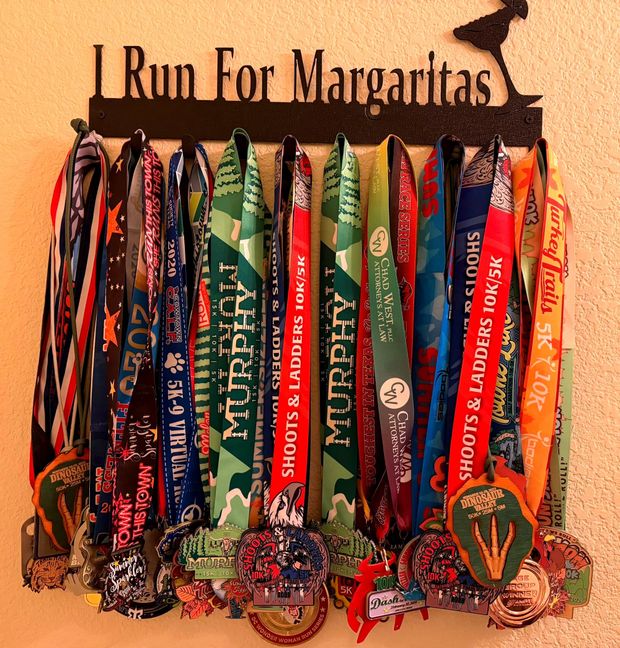
Three hosts. Three race distances. Only one can be the best.
On this episode, Jen, Abbie and I face off in the ultimate running debate: the 5K vs. the half marathon vs. the marathon. Which race distance is really best for runners over 40? Each of us makes our case built on training time, mental toughness, recovery, strength training and even heart health. And yeah, maybe I brought some research to the debate, even though I wasn't supposed to.
Along the way, we share how they push through the hardest miles, a hot and humid race-day story that went sideways, and a bit of news that might pull one host back to the starting line.
Enjoying Practically Fit? Listen on Apple Podcasts, Spotify, Amazon Music, or YouTube, or wherever you get your podcasts. If you like what you hear, a rating or review on Apple Podcasts really helps. Get every episode and our weekly content straight to your inbox by subscribing below.
Who made the strongest case? Listen in, then tell us your favorite distance in the comments, or shoot us an email at alex@practically.fit.
Read The Transcript
5K vs. Half vs. Marathon: The Great Race Distance Debate
Alex: Welcome to Practically Fit, Real Fitness Over 40. I'm Alex.
Jen: And I'm Jen.
Abbie: And I'm Abbie.
Alex: Today we're going to have a debate: what is the best race distance for running? I will be arguing on behalf of the amazing 5K. Jen will be arguing on behalf of the terrible marathon. And Abbie will be arguing in favor of the somewhat terrible half marathon. That's the plan for today's podcast. We thought it would be fun to have a debate about which distance is the favorite. And yes, I have gone up front and already started trying to win the debate.
Jen: Oh, you've prejudged it already, Alex.
Alex: The way we're going to do this is we'll go through each distance, and one of us will make an argument in favor of that distance, and then we'll react. So who wants to go first?
Jen: I think I should go first, because mine is the longest and most terrible, according to you.
Alex: See, you're already undermining your chosen distance. So, Jen, you go first. Give us your first positive in favor of the marathon.
Round 1: The Mental Challenge
Jen: Okay. I've thought a lot about this, and I think what I love about the marathon is that it's actually more of a psychological test than a fitness test. There's really no way to know exactly how it's going to go, so it's about the mental game of figuring out how I can stay in this, mentally, even though it's painful physically. I know that sounds a little masochistic, but I like the mental challenge of the marathon.
Alex: That's interesting, Jen. Let's talk about that a little more. How difficult have you found it when you've done marathons? I'm curious to ask Abbie this question as well, because she's done at least one marathon. Talk more about the challenges you face in the middle of the race.
Jen: Well, you can train really well and you still never know what that particular test is going to bring. I've run ten marathons, and they've all been different, and challenging in different ways. So it's more about having an action plan for when things start going wrong, when things get difficult and painful: how are you going to stay in it? I'm happy to share some of my strategies for that, or we can talk about them later. But I try to take it a little at a time, one foot in front of the other. It makes you boil it down to the basics, and that's another thing I love about the marathon. In a way, it's very pure, because it's always going to bring something at you that you haven't foreseen, so then it's how do you keep yourself going forward in the most literal way. I love the mental challenge — it's like chess, in a way.
Abbie: Yeah, that resonates really well with me, Jen. I've only done one — I haven't done ten, I'm not as masochistic as you, obviously. But I agree, because what it really taught me was that it didn't matter what I had done in training. Race day threw a whole bunch of stuff at me that I wasn't expecting, and I had to adjust en route and figure it out along the way. And I also think there's an amazing feeling of crossing that finish line, which is very different from other races because of that, along the way.
Jen: 100% correct. Fair point.
Abbie: Although I would still argue that you can get that with a half marathon without quite as much time in the pain cave.
Jen: What about you, Alex? What do you love about these short races?
Alex: Well, I think there's a mental challenge in a 5K, because you're going at a faster pace and trying to maintain it. It's usually the back half of the race where you face a different type of mental challenge. It's a pain cave as well, and if you can get to the point where you can see the finish line, you can usually turn up the intensity. So I do believe a 5K has the same type of mental challenge, and thus I'm slightly undermining your argument in favor of the marathon.
Abbie: I'm going to jump in here and argue that the half marathon is the perfect balance between the two. I hate the first two miles. A 5K is only three miles, so you're hating 66% of the race. Whereas I think the half marathon is the perfect combination, because you're testing yourself physically and mentally. You're able to get into a rhythm and a pace, but you're not having to hold it for as long as you would for the full marathon. That's why I think the half is the perfect distance, and you will not convince me otherwise.
Jen: Well, challenge accepted. Actually, I'll tell you, Abbie, the half is my favorite distance, but I don't know if it's the best, and I think those two things can be different. The half is the one I prefer. It's the exact right middle ground of challenge, as you're saying: challenging, but not miserable. But the marathon exacts something of me that's so different, and so much more than I think I could ever achieve otherwise, that it's probably more that feeling of achievement. For me, the marathon is also a gratitude practice. I'll give a very specific example: once I volunteered at the finish of a full marathon, and just seeing people's faces — people were in tears, people were exhilarated, that "I can't believe I actually did it" feeling — I think part of it is just that it's so hard. It helps me realize I can do more than I think I can. So that's why I'm going to argue in favor of the marathon. Alex, you probably have a version of this, because you've actually gotten really fast at the 5K. What's the different challenge you're saying is there for the 5K?
Alex: I think it's more around speed. You hit a point in the race, usually, where you think, I can't keep up this pace. You can keep up the pace if you've trained for it, but it's a mental challenge to keep it. I usually start to hit that at a mile and a half to two miles, depending on the weather, especially in Texas when it's hot. So I feel really accomplished when I'm able to keep that pace up — or, an even bigger challenge, do a reverse split, where I rein it in early on and then increase my pace on the back half of the race. What's really fun about that is you start passing people, and it's a great feeling. If you're nailing the pacing and you do a reverse split, you can pass a bunch of people at the end, even in the last tenth of a mile, which is the ultimate feeling. This sounds terrible — I'm so competitive — but there's nothing like running past people as you're heading to the finish line. It's terrible, I'll say it, but it feels great. You think, yeah, I passed you at this very critical point, it was really challenging, and I was able to speed up. So for me, that's the challenge of a 5K.
Jen: Oh, well, I'll turn that around. You said the 5K is a mental challenge, just like the marathon is. I'll say the marathon is competitive in a very different way. I'm not fast enough to win marathons, or even be at the top of the pack, but I think I'm really competing with myself. It goes back to this idea that it's something so hard that I'm always amazed I can actually finish it. So it's more self-competition, and a feeling of challenging myself to do something that feels like more than I can possibly do. But full disclosure, Alex, I really don't like the 5K, because I hate running fast. I hate it in every form and fashion.
Alex: Abbie, you might agree with that, and that's one of the reasons I like it. We'll get into that more. Okay, so Jen's argued her first point for the marathon. Abbie, let's go in reverse order of distance. What's your first big point in favor of the half marathon?
Abbie: I kind of alluded to it already. I think it's the perfect distance because you're not having to sprint all out, but you do go faster than you would for a marathon. I find that distance-and-speed equation of the half marathon is the perfect blend for me between really hard and still a mental challenge, like Jen argues. And I just don't feel the same about the 5K. I get what you're saying, Alex, but to me the 5K feels like a physical challenge. I don't find a 5K a mental challenge in the same way I do a half marathon or a marathon. So it's that perfect mixture: I will push myself in terms of speed, but not all-out sprinting like you would in a 5K, and it's not as long as a full marathon. I think I've done 15 half marathons now, so I'm definitely in your camp, Jen — that's why I'm arguing for the half marathon. Every one of them has been different. I've even done the same race, two of them twice, and they've been different each time. I think it's humbling, too. Especially when you get to mile 10 or 11 in the half marathon, I'm like, I just want to stop, and you know you have to push yourself through. I'm always amazed that I'm able to achieve that distance and cross the finish line. So for me, it's that perfect blend of speed, physical and mental challenge, achievement, and self-reflection.
Staying in the Race: Mantras, Music, and Looking Outward
Jen: I'll jump in for a minute. One of the things we have in common, even though we're arguing for different distances, is that they're all challenging. Alex has said the 5K can be challenging in its own right, because it's very compressed and you want to do your best. So I'm curious: how do you deal with those challenges when they arise?
Abbie: That's a really good question, Jen, and it's something I've reflected on, coming back to running after taking a break and having an injury. I've had to adjust my expectations, and adjust the comparison to myself, because like you, I'm never going to be winning a half marathon. I'm not as fast as Alex is at the 5K. So I've really had to think about what racing is teaching me, and how I stay in the race and stay with myself. I've really reflected on how much more of a somewhat spiritual practice I find racing a half marathon, because you get to that place where it feels really, really hard, and you have to dig into yourself and talk positively to yourself. I think there are three things I focus on. One is music — having a playlist that picks me up at different moments really does help me through. The second is breaking the race down into segments and thinking about a person or a thought during each segment that helps me motivate through — someone near and dear to me, or even the fact that some people can't do this, and my body is allowing me to do this amazing thing, and being really grateful for that. The third is mantras. This has been true for me for the half marathon and the marathon, much more than the 5K: I just say, "You're really strong," or "You can do this," talking to myself in that positive frame. I actually saw something on another creator's page the other day saying, say to the person you're passing the thing you want to hear yourself, like, "Hey, you look really strong today." I thought that was really beautiful, and I'm going to do that at my next race, because putting it out there into the world for someone else gives it to you.
Jen: Mine are very similar, so I don't have much to add. I do have one thing, though. When things get really difficult during the marathon, sometimes I turn my attention outwards and stop thinking about everything I'm experiencing in terms of pain and boredom — boredom is a big issue in the marathon. I turn outwards to the people around me. It always astounds me: at the New York City Marathon, for example, there are throngs of people who have shown up to cheer for complete strangers, to hold signs and give up their day. I think about that instead of the pain I'm in, and about the joy of this shared experience. Alex, what do you do when things get tough in your 5K?
Round 2: Time, Boredom, and Life Lessons
Alex: Well, that's a great transition, Jen. Let's go to my first point about the 5K: 5K training can fit into your schedule better, because it takes less time. And guess what? You're running a little faster, you have less time to do your workouts, which means it's not boring. That's my counterpoint to the marathon and the half marathon: they are boring, like you said, and the training takes a really long time. I remember when I was training for half marathons — I've never done a marathon, full disclosure, and don't plan on it — but even for a half marathon, Jen, we went out to White Rock Lake back in the day in Dallas and ran that loop, what is it, 12 miles? It's so boring. You get halfway around the lake, and you can see to the other side, and you think, I've got to run all the way over there. I'm so bored. There's only so much I can talk about for two hours or whatever it is. And there's only so far music will take you, Abbie. I know you said the playlist is helpful, but you'd have to make it pretty inspirational at some point to get through 26.2 miles or 13.1 miles. The great thing about training for a 5K is that you don't have to run as far. So for people over 40, our audience, who are busy — maybe they have kids, maybe they're really busy with work or extracurriculars with the kids, or they're dating, I don't know — less time has to go to your running training. Boom. Is everybody sold yet on the 5K?
Jen: It's a compelling argument, I will say. One of the hardest things about marathon training is that it's somewhat like a part-time job. Particularly if you're a slower runner like I am, a 20-mile run is basically your Saturday. So there's that, but then there's the payoff at the end of doing something that seemed utterly impossible, and yet there you are having finished 26.2 miles. It's pretty exhilarating, I have to say.
Alex: With the 5K, there you are having passed people close to the finish line and made them eat your dust, and it's an awesome feeling. Abbie, do you have any response to anything I just said? Because you're making a face.
Abbie: No, I mean, it is a good point, babes. I do love fitting it into your day-to-day life. But I would also argue that for the half marathon, you aren't doing 20-mile runs on the weekend, so you can fit the half marathon into your day-to-day life too. And I think you recover more quickly from a half than from a full, for argument's sake. And I think we're getting a little insight into your super-competitive brain, Alex, where you're comparing yourself to other people. But I would agree with Jen, actually. That's why I prefer the half marathon to the 5K: I'm never going to be fast enough at the 5K to be passing lots of people at the end and feeling some of what you're arguing for. For me, the half is a level of difficulty and a distance that fewer people do. More people do a 5K, fewer people do a half marathon, and even fewer do a full marathon, and that's part of the argument I could see in Jen's camp. You're in the less-than-1% club for the marathon, right?
Alex: I will say, as a counterpoint, I'm definitely not passing 15-year-olds or 20-year-olds. I'm passing people in my age group. And Abbie, I've seen you do that in a 5K race, so you can pass people in your age group. Point to Alex. All right, let's go to the next round of positives, and we'll go back to Jen. What do you have to offer us next, an argument for the greatness of the marathon?
Jen: Okay. Well, I'll say the marathon has taught me a lot about life. I've learned a lot about how to approach really difficult challenges outside of running through running the marathon. As I was saying, running a marathon takes a lot of discipline, a lot of training, and a lot of willingness to be uncomfortable, and in doing that, I've learned how to do that better in life. When I have work challenges, or I'm moving across the country and things feel really hard, through training for and running marathons I've learned to put one foot in front of the other and to turn my attention to all the good outside of what I'm experiencing at the time. So I'd say the marathon has taught me mental resilience, and that's something very valuable to me. Sometimes you have to do things the hard way to realize that you can dig deep and do more than you think you can.
Alex: Yeah, that's an amazing point, Jen, and I'm not going to joke around on this — that's an awesome thing you just shared, and definitely something I could see being a big benefit. I think it's similar even beyond the marathon, with ultramarathoners. I would imagine there's a similar benefit to completing that challenge and finding motivation. So I think that's awesome.
Abbie: Yeah, that massively resonates. I think that's what draws people to a marathon, or to other crazy challenges like climbing Kilimanjaro. You see people doing these things that seem impossible, like such a feat, and I can really see that. It makes a ton of sense. But it can also feel overwhelming for people, I think, and that's where the half marathon is the perfect piece, giving you some amazing challenge and some mental endurance and lessons. I actually think that's true of running, full stop. There are so many life lessons you get from running, not even considering what distance you run, just from the discipline itself.
Round 3: The Race-cation
Alex: All right. Abbie, what do you have for us next on the half marathon?
Abbie: Oh, I have a good one for my next one. I think the half marathon is the perfect race destination distance. If you're going for a race destination, a 5K feels unjustifiable — you're only going to be out for a small amount of time. I don't feel like you can build a race destination around a 5K. And the marathon is such a challenge that I feel it's hard to enjoy the destination before and after the race. Whereas I think the half is perfect for a travel race, because it's not so difficult to recover from. You can get out and enjoy the city or the location you've gone to, and it feels like enough of a challenge to justify traveling to an amazing place. So I would argue that for the half.
Alex: I'm not surprised you've brought travel into this, because you love to travel. And I'll say that's a salient point. It makes sense to me, because you're totally wrecked after the marathon, I assume — y'all would have to tell me. If you've gone somewhere really cool and you want to go out right after and have fun in some amazing city, that makes sense. Although I will say, when we were in Paris last year, we saw a lot of people after the marathon who could barely walk. And, Jen, you've told me about the New York City Marathon and the toll just getting to the race takes — you've got to take a ferry, because it goes through all five boroughs, right? Anyway, salient point, Abbie. I'm impressed with that one. I'd definitely give you a point. Jen, do you have any thoughts on the travel aspects of half marathons versus marathons?
Jen: Oh, I'm totally with Abbie that you have to at least run a half marathon to travel. A 5K, 10K, is kind of maybe, but I just would not feel justified traveling somewhere to run a 5K. So I totally agree on that. One slight thing I'd argue for the marathon is that it's a great way to see a place. 26.2 miles covers a lot of ground. New York is a great example: you go through all five boroughs, and the first entire half marathon is just Brooklyn. It's a great scenic tour of the city with a little bit of pain thrown in.
Alex: All right, counterpoint to both of y'all. The good thing about the 5K is race availability. If I want to do a 5K this weekend and I live in the DFW Metroplex, for example, or near another major city, I can find one, two, three, four, or five 5Ks this weekend that I could sign up for, and they probably have beer associated with them as well. Just a counterpoint on that.
Strength Training and Recovery
Alex: I'll give you my next point in favor of the 5K, and I'm building up to my big argument here, which is going to totally dismantle both of you. I talked about 5K training fitting into your schedule better, and an added benefit is that it gives you more time for something that's very important for us aging folks. We're all over 40 here, and some of us are older than others — not me. Ha. Y'all are really going to gang up on me. I know, we're doing a debate, you knew I was going to get competitive. But in all seriousness, as we've talked about on the podcast, it's really important as we age that we're doing strength training. I think it's a lot easier to fit a significant amount of strength training into your weekly schedule if you're running less. If you're doing legs, for example, you need to work that into your strength routine, and it's hard when I'm running longer distances, because my legs get really tired. I don't know about y'all. With 5K base training or the shorter distances, I think you have more time for strength training, and it makes it a little easier when you're thinking about lower body training as well. Care to respond, either of you?
Abbie: Yes. That's a fair point, Alex. I must say, this topic is bringing out your hyper-competitive side. But I still think you can fit in strength training around training for the longer distances. What I would actually argue is that it requires you to be more disciplined about how you manage your routine, which is something I quite like about it. You have to be strategic about where you place the sessions, but I think you can still fit in enough variety. In my case, I can't train for a half marathon, or the time I trained for a marathon, without not only strength work but also a lot of stretching and recovery sessions, which I think you can get away without doing if you're 5K training. So I'd argue it makes you more disciplined about those, not less.
Jen: Yeah, I'm going to agree with Abbie there. One thing marathon training has taught me is the importance of recovery. In shorter distances, and even in half marathon training, I haven't had to pay attention to it. But after those really long runs, how you recover is really important: getting some protein and adequate rest. That's really hard for me — I don't like to deliberately take time recovering — but you kind of have to in the marathon, in addition to, as Abbie was saying, doing some strength training and stretching. I love that it slows me down in a couple of ways: both the running pace, where I have to be very humble about how fast I can actually run, and also forcing me to recover. So that's another point for the marathon in my book.
Alex: Well, great points that you both make. I'll just say again that I've got a lot more time in my schedule to do recovery and mobility and stretching because I'm doing 5K training. That's the conclusion to that round. Let's go to the next round. Jen, you're up with the marathon.
Round 4: Feeling Alive, and No Shortcuts
Jen: All right, this one's very simple, actually. The marathon has made me feel alive in a way that other races haven't. I think 5Ks are fun, I've done them before. The half marathon, as I disclosed, is my favorite distance. But the marathon truly has made me feel alive. I can remember every detail of all of my marathons; the half marathons kind of run together for me. Something about the endurance required, and even, I have to say, the physical pain, just makes it more memorable and more worthwhile. So that's my last point in favor of the marathon — again going to the esoteric and psychological. I love the psychological challenge and how it makes me feel alive.
Alex: That's a great point, Jen. I've read similar things in books — we talked with Matt Fitzgerald recently, and he talked about that. I've read other books where the authors describe that same effect, like they feel completely alive when they're taking on this challenge. So I think that's a really cool point.
Abbie: Yeah, I think that's an excellent point, and I do think there's something very unique and special about a marathon, so I agree with you on that, Jen. Crossing the finish line at the half marathon, I was humbled and emotional in a way that I wouldn't have been at a different distance. So I think that's a fair point.
Alex: All right, Abbie, over to you on the half marathon. What's your big point in favor?
Abbie: Well, I came out strong with my big point on the travel. But one last point I'd make is that you can do half marathons more frequently. There's a quicker recovery, and I think you do less overall damage to your body. So I think they're more accessible. I do worry about people jumping into a full marathon unprepared, not realizing the magnitude of it. There's a very good reason it's a humbling experience, and why less than 1% of people do them. You have to be careful with a full marathon. It is a huge physical impact and toll on your body. Whereas I think the half is a little more accessible, and still a really humbling experience. And I would disagree with you, Jen — I remember every single one of my half marathons, and they're special memories for me in different ways. Whereas I think 5Ks do blur, maybe because I just hate holding that pace for 3.1 miles — it's a whole world of pain. But yeah, I think the half is more accessible, it's really challenging, and you can recover quicker. And I actually think if you do them right, they're really good for your health. They give you structure and routine without overloading the damage, and you can pick up after them quicker than you can from a full.
Jen: I'm going to pick up on one point you made, Abbie, which is that you can't take shortcuts in the marathon, and it would be somewhat dangerous to. My very first marathon was a total disaster. It was in San Antonio, Texas, and it hit a high of 80 that day with legit 80% humidity. It was miserable. But I was running beside a guy who had not run more than six miles in his training, and there's really no way to complete a marathon comfortably without having done the training. So I'm going to take this as a point in favor of the marathon: you can't take shortcuts. That's one of the things I love about it — it doesn't let you off easy. I have to say, I've phoned in some races I didn't really train for, but I don't think I can finish a marathon if I haven't done at least some portion of adequate training for it. So I like that it doesn't let me off the hook.
Abbie: Yeah, that's a really good point. And Jen, that's so funny, because the marathon I did was San Antonio, and it was also ridiculously hot and humid. I think it rained for four miles — it threw everything at you that day. It was like 90% humidity to start, then rain, then it jumped up to 92 degrees and the sun came out. Because you're out there for so long, it's brutal on your body to manage those conditions. Whereas, Alex, we did that 5K in the summer, right? That was hot and horrible, and I thought I was going to die and throw up, but it was 30 minutes, so you could survive that.
Alex: I'm just curious, do y'all think y'all ran that race in the same year? What year was that?
Jen: Oh no, it was quite some time ago. I have the T-shirt, but I'd have to look it up. I'm sure it was well before Abbie.
Abbie: Mine was, I think, 2017.
Jen: Oh yes, mine was definitely before that. And it didn't rain. I would have remembered that.
Abbie: Yeah, it rained for like five miles. I was enjoying the rain because it was early in the race — oh, this is lovely — until about mile 17, when I thought, okay, my socks are still wet from the rain, but now it's 92 degrees and the sun's out. It was just miserable.
Alex: My takeaway from all that is: don't run the San Antonio marathon.
Alex's Closing Argument: Health and Heart
Alex: All right. I'll now share my last point in favor of the 5K, and just like a 5K race, I'm going to finish strong. I saved my best point for last: with the 5K, you can maximize your health gains. You get the benefit of running without the drawbacks of longer training, including the time it takes, which I've already touched on. I found a study in the Journal of the American College of Cardiology finding that even five to ten minutes a day of low-intensity running is enough to extend life by several years compared to not running at all, which is great, right? It shows that the minimal healthy dose of exercise is smaller than people might assume. Over 15 years, those who ran 50 minutes a week or less at a moderate pace were less likely to die from cardiovascular disease or other causes compared to people who didn't run. We know running reduces your stress and the cortisol that causes it, it brings in endorphins, and it helps your mood. Running shorter distances is also really great for your health because you can run faster, as we've talked about, and that helps increase your VO2 max. You can bring in interval training — you could do that for a half marathon or a marathon, but I just think you have more time to do it when you're training for a 5K. And VO2 max, as we've talked about previously on the podcast, is a major health marker. Now I'm going to take this a step further. That's all in favor of the 5K, but let me go a little negative here, on Jen first. I found an article by a guy named John C. Hagen III, called "Marathon Running: An Unhealthy Addiction." I loved his bio at the bottom of the article. He was very confident that his long-distance running would guarantee a healthy heart. However, he now believes that 45 years of maximum endurance exercise contributed to his atrial fibrillation and high coronary artery calcium score. He's the editor of Missouri Medicine. I'll read you a little paragraph from his article: the primary 2014 conclusion by Schwartz, Kraus, O'Keefe, et al. was that veteran marathon runners had higher coronary artery calcium scores than age-matched non-marathoner cohorts. That's a surrogate for coronary artery plaque burden, and if you have a value higher than 100 on this test — which, Abbie, I'm supposed to take, and I just haven't done it — it raises concerns for heart disease and increased cardiovascular events, and arrhythmias like the author had. His point was that there's some potential damage to your heart from marathons. I also saw some research that sort of debunks that theory, so I'm undermining my own argument, but there are different viewpoints on this, and I thought it was really interesting to read about. A lot of it could be attributed to running many, many, many miles every week. So that was me going negative against Jen. Abbie, I also think that with long distances, even half marathons, when you're doing long runs, it can cause muscular strains and injuries. I think somebody on this call didn't do her long run today because her knee is hurting. And I just don't have those problems with 5K training. So there is my final argument in favor of the 5K. I'll hang up and listen.
Rebuttals
Abbie: Well, Alex, you said there was no research this week, and then you went and threw a bunch of research at us. I'd like to pick up that point first and foremost. But fair point in terms of the research on the impacts on those health markers. I also think that running, for me, isn't just about cardiovascular health — it's mental health. The longer distances give me benefits from a mental health perspective that shorter distances just don't. So I think there's a balance in terms of those health impacts, and it's not just about cardiovascular fitness. I'd also argue that those studies are comparing a person over here who's doing marathon training with a person over there who isn't. The only way I'd feel really solid about that is if it were the same person, and the only difference was whether they were doing marathon training or not.
Jen: I'll pick up there. I think that's a fair point. When I started running marathons, my primary care doctor said, hmm, I think the half marathon might be the perfect distance — the marathon's really challenging. So point to Abbie on that. But I will say — and this is also my final point in favor of the marathon — we only live once, and you miss all the chances you don't take. Like Abbie said, for me it's about mental health, and about proving I can do something I thought was impossible. And the last thing I'll say is that sometimes you don't have an option. When I first won the lottery to run the New York City Marathon, they don't have a half marathon option. My first thought was exhilaration — I'm so excited, I'm in! — and then I thought, oh, now I have to train for a full marathon. But I wouldn't have had that experience without it. So my final point is, like I said, we only get one go at this, and running marathons has made me feel alive and accomplished in a way I hadn't felt before.
Takeaways and Wrap-Up
Alex: Great points, Jen and Abbie. This is all in good fun, because we think there's benefit to running in general. What was a big takeaway for me, listening to y'all's viewpoints, is that each of us is motivated a little differently by these different distances. So for everybody who's listening, you probably have your favorite distance, and there are very distinct reasons why. Finding that motivation for your fitness, health, and mental health is really important. It's pretty cool to hear each of our different arguments in favor of these distances.
Jen: Yeah, absolutely. I enjoyed the discussion. I'm going to leave with some news: before we did this podcast, I had officially, within myself, retired from the full marathon distance. I'd run ten, and I thought, well, I'm done. And then my friend here in California and I did something crazy, and we both put our names in the lottery for the Chicago Marathon. So there might be one more marathon in me. We'll see.
Abbie: Oh, a great one, Jen. The Chicago Marathon will be an awesome one to do. If you get in, we'll be there to cheer. Maybe I'll change my mind after that.
Alex: You can also check out Berlin — that's Abbie's next big half marathon. Speaking of destinations, right? So, benefit there. Well, that was a really fun debate, y'all. I appreciate y'all doing this with me, and I hope the listeners enjoyed it. We'll wrap up for today. Feel free to go to your favorite podcast platform or our website, practically.fit, and leave us a comment on who you think won the debate, or which distance you favor most. We'd love to hear your reasons, and we'll share them on the podcast. You can also shoot me an email at alex@practically.fit. We'll have more great content coming for you soon. And remember, when it comes to fitness, you don't have to be perfect, you just have to be practical. We'll catch you on the next one.