Last year, I started experimenting with creating a strength workout in ChatGPT. I wanted to switch up my routine, so I thought, “why not try this generative AI thing for something more than helping me brainstorm catchy titles and headlines during my day job?”
Here was my initial (and unsophisticated by today’s standards) prompt:
Build me a bodyweight progression workout that includes pushups, pull-ups and lower body exercises. Include how I can progress to more complex and challenging movements.
Over the course of about a month, I worked with the chatbot to design a hybrid bodyweight and barbell workout. I’d provided the app with all of my available equipment, including blast straps, which are nylon suspension training straps that I’d previously used to do pushups. Blast straps make pushups harder by taking away the stability of the floor that’s present during a traditional pushup.
After Abbie and I recorded this week’s podcast (more on that in a moment), I went back and reviewed this chat. As you can see below, while I was working with the app to develop the workout, it introduced the idea of using gymnastics rings, probably based on me owning the blast straps.
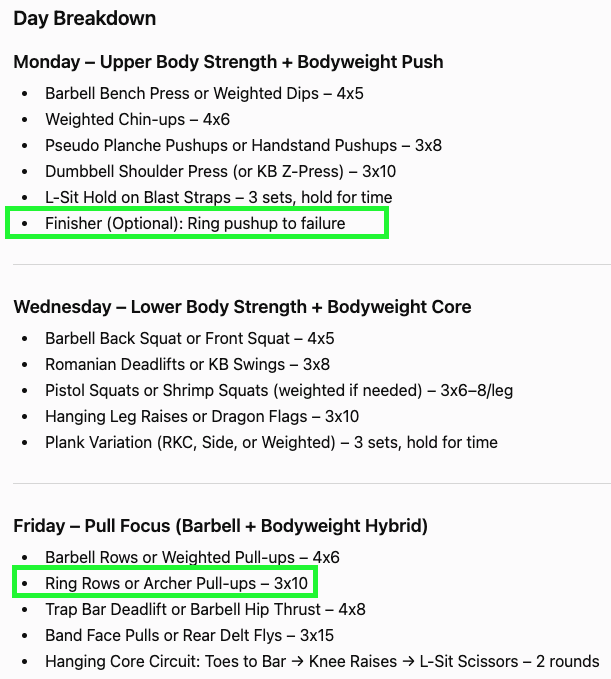
Even though I didn’t currently have gymnastics rings, I’d used them ten years before (when I was younger) and enjoyed them. Now, 44-year-old me thought, “yeah, that sounds like a fantastic idea!” With the mere suggestion of new gear to be purchased, I promptly went onto Amazon and ordered a pair of rings, because that’s what I do.
As all the back-and-forth with my generative AI friend continued over the course of a month, the app subtly suggested the option of ring dips…and my hyper-competitive brain, which always wants me to push toward more complex movements, took the challenge. I could use my new rings for something more than pushups and rows!
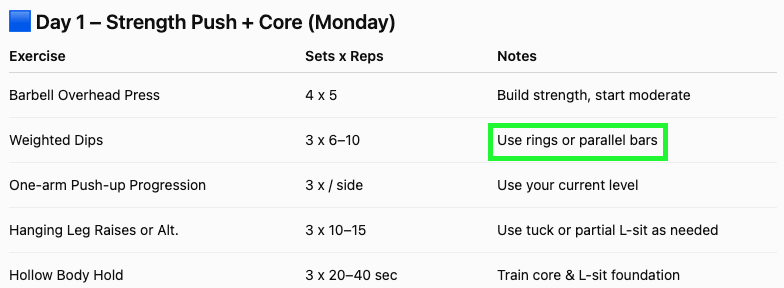
Fast forward another month or so, and here’s one of my prompts to ChatGPT:
I hurt my shoulder during the push portion of the workout last week and have been resting. I wonder if doing both the military press and the ring dips puts too much stress on my shoulder? I have been enjoying the dips and would prefer to keep them in the workout. Thoughts on how I could adjust the workout?
I share this embarrassing prompt with you as a lesson. As someone who is experienced with strength training, I should have known not to do ring dips in the first place, without building up my general dip strength from scratch. Tongue-in-cheek podcast title aside, it was my fault I got injured doing ring dips, not AI’s.
That said, for people who aren’t experienced, there’s still a danger here, even though these models are improving. Taking AI-based fitness advice could prove dangerous, and it’s always good to have someone who knows what they are doing—whether it’s a friend or a personal trainer—help guide you in your workouts.
I shared this story on this week’s podcast, where Abbie and I talked about our recent experiences with using both AI-enabled apps, like Runna and Garmin, and generative AI apps like ChatGPT and Claude, to help us with our workouts. We discussed the promise and the pitfalls of incorporating AI into your fitness routine, including unbiased reviews of our experiences with these rapidly-changing apps.
Please leave a comment below, or shoot me an email at alex@practically.fit. We’d love to share your comment or question on the next episode of the podcast.
Read The Transcript
Alex: Welcome to Practically Fit, Real Fitness Over Forty. I'm Alex.
Abbie: And I'm Abbie.
Alex: And today we're going to talk about the benefits and pitfalls of incorporating AI workouts into your fitness routine.
Abbie: That's right. AI is becoming more pervasive in society, and that means it's becoming more pervasive in fitness. Over the past few years we've been experimenting with different apps that incorporate AI features, and we're going to share our experiences with those today. More recently, we've also been using generative AI chatbots like ChatGPT and Claude to help shape our workouts.
Alex: Yeah, so we're going to share all our experiences with different apps and chatbots today. But one key takeaway I wanted to throw out up top, from experimenting with all these tools, is that because AI is prone to telling you what you want to hear — or even reinforcing your existing beliefs — you have to be careful with its advice. We'll talk more about that as we go. But let's kick this off by talking about our experience with AI features in fitness apps themselves, and we'll move on to generative AI chatbots in a bit. So, Abbie, do you want to kick us off with some of your recent experiences with apps?
AI Fitness Apps
Abbie: Yeah, absolutely. So a couple of years ago I came across Runna, and I did a free trial with it.
Alex: Wait, how do you spell that?
Abbie: Runna — R-U-N-N-A. I didn't realize at first that it's a British app, but it is.
Alex: By the way, it's been bought by Strava now.
Abbie: So it's now embedded into Strava — I think you can even do a bundle subscription between Strava and Runna now, whereas when I first picked it up, it was a separate subscription. Anyway, I was getting back into running at the time and wanted to structure my training. I found it through a Reddit thread — love a Reddit thread — started using it, did a week's trial, liked it, and launched into a subscription. Overall, I think it's a really, really good app — lots of solid positives, lots of good experiences. But I want to be fair and run through both the good and the bad. On the positive side, what I really like is that it's very structured and gives you a clear plan you can follow, and you can also tailor it to yourself. You can tell it if you're training for a race, and it'll build toward that race. If you've got a goal — both Alex and I have used it for a 5K improvement plan — or even if your goal is just to maintain your current level of fitness, I think that's really nice. You can also specify how many days a week you want to train, which days you want to run, and especially which day you want to do your long run if you're training for a longer distance. One of the other things I love is that if you have a fitness watch — a Garmin, or any other brand — it syncs to it. I have a Garmin, so I don't know exactly what else it syncs to, but I know it does Apple Watch, and so on. What's really beneficial about that is the app lays out these different workouts for you across the week, and it's just there on your watch that day for you to click in and do the workout. That's particularly helpful when you're doing an interval workout, or a pyramid set — a set of intervals at different distances that build up and then build back down. It keeps you on track during the workout, which is really beneficial.
Alex: Yeah — and I think what's good about it is that it's ingesting all your data, so as it's setting up those different sets for you — whether it's an interval workout, pyramid sets, a tempo run, whatever — it's adjusting based on your real run data. That's kind of where the AI comes in, right?
Abbie: Yeah, it does — although I'll talk about that a bit more in a moment, because I actually think that might be one of the downfalls of the app, from my experience. It's got a really nice, easy-to-use interface. I particularly like that it has really clear descriptions — it's really clear in each workout what you're doing, what paces it wants you to hit, how it wants you to run, and that comes through on your watch too. There are also lots of tips and tricks in the app — videos showing you how to do a good warm-up and cool-down. You can add in strength training and mobility work and all kinds of things, so there are a lot of options you can build into the app. One of the things I've most appreciated is that it introduced me to some new workout types and formats I hadn't done before. Before this, I'd run with a running club and done training plans you could download offline, like Hal Higdon's, and I'd generally done the same things — easy runs, tempo runs, fartleks, different kinds of intervals. But this introduced me to some of my absolute favorite workouts now. I really love a pyramid set — I find it really fun, I love the build-up and the build-down, it makes the time go fast. It's introduced me to broken 5Ks and different types of interval training sessions, which has been really fun. I know you've found that too, Alex, right?
Alex: Definitely. I think for a running app that's incorporating AI and all your data, it definitely has the best variety of workouts to choose from. You can even go in and decide, "I want to do this kind of interval set today" — like something you'd do on the track, say 200-meter sprints — and it already has a workout built for that. Very cool.
Abbie: Yeah, I really agree. And last, in the pro category — it's pretty cost-effective versus hiring, say, a personal trainer. I have other running friends who've hired a coach, and that's pretty expensive and not accessible for everybody. But in terms of getting some of that structure a coach would give you, for a more affordable price, I think it's pretty cost-effective.
Alex: Yeah, although I will say it's still a little on the pricey end for a fitness app, if you're paying month to month.
Abbie: Yeah, and if we move into the cons, that's definitely one of mine. There's a cost consideration — you do have to pay for the app — but compared to hiring a personal coach, it's much cheaper.
Alex: Yeah, definitely.
Abbie: Cost would definitely be one of my cons. I think the two biggest cons I'd pull out are, first, that while you can set it up around your goals, adjustments are somewhat limited. It's not the same as having a personal coach, where you could say, "I need X and Y," or, "This isn't working for me," or, "I'm concerned this pace is pushing me too hard." There's no way to feed that back into the app and say, "This was too difficult."
Alex: Yeah, I haven't used this app in a while — I used it last year, and you've been using it more recently. I remember there was a notes feature, but I don't think the AI actually incorporates whatever you put in your notes into its analysis of your workouts.
Abbie: I don't know — I haven't used the notes feature.
Alex: Yeah, so that's something to investigate.
Abbie: Yeah, I haven't used the notes feature, so I can't comment on that. But what I was really getting at is that there's limited ways to give feedback and adjust things like paces and workouts if they're too hard. And a lot of what I've seen is people being pushed into overtraining. The way the app works is, when you set it up, it asks for some baseline data — when I set it up the first time, I put in a recent 5K time and my weekly mileage. Now, if you're a beginner runner, that could be pretty risky, because you don't have that data to put in. I think that's one of the big cons I'd pull out.
Alex: Yeah, and I think as these apps evolve, they need a way to take that into account. If it wants to be a truly effective AI-driven app, it needs to be able to take feedback. I'm curious how long it takes before these apps can actually do that.
Abbie: Yeah, and I'll say it has evolved since I first started — you can now request a holiday, and it'll build a break into your schedule, which is really nice. When I first started using it, we went on vacation and there was no way to do that, and I wasn't going to be running four times a week doing the kinds of runs it wanted. The second thing is, you're not talking to a real person. Going back to the cost-effectiveness point — yes, it's cheaper than hiring a personal coach, but with a coach you can actually talk to them and say, "Oh my gosh, that pace was really hard to maintain," or "I'm getting these niggles in my body" — you can talk to them about what's going on. As I mentioned, I think the risk is that it can lead to overtraining. I've personally found that sometimes the pacing and mileage recommendations it gives me are a bit intense. When I did a 5K plan a while back, it had me doing long runs of seven or eight miles, and I was thinking, why am I running seven or eight miles for a long run on a 5K plan? That seems high. I was okay doing them because I was already used to that distance, but if I hadn't been, that's a lot of mileage to put on a body. So I think the most important thing I've found is: trust yourself and know your body, rather than rigidly following the plan.
Alex: Yeah, the other thing I'd mention about Runna, or similar apps that give you these really structured workouts based on your data, is that they don't take the weather into account. For some people that's maybe not as big a deal, if you live somewhere temperate, or somewhere that's often cool. But when you live in Texas, and it's hot in the summer — even in spring and fall — some of the workouts they're prescribing really need to be adjusted for temperature, humidity, dew point, all of that. So you don't really know, especially with those intense paces you mentioned, what you're actually supposed to be doing. I think that's a downside of some of these apps — they can't account for weather conditions.
Abbie: Yeah, no, definitely. Although I have seen that start to shift a bit — I wonder if that's the Strava integration, or even Strava's investment, helping it take some of those weather factors into account.
Alex: Yeah, it'll be cool to watch this app develop over time, especially with the Strava partnership, and as AI accelerates in general. The other one I've tried is the built-in Garmin coaching plan. Abbie mentioned we both have Garmin watches — love our Garmins — but the Garmin app itself has these built-in coaching plans. The reason I went down this path was the cost of Runna that I mentioned earlier — the monthly cost seemed a bit steep, so I thought, why pay that when I've already got something built into my watch and the Garmin app? So I tried the Garmin coaching plans, and honestly, very similar pros to what Abbie described with Runna. The one downside I noticed with the Garmin plans was in the overall setup. The way it works is similar to Runna — you put in your parameters, like, "I'm training for this race," or "I want to improve my 5K pace," and it gives you a plan spanning several weeks. You also have the option to select a different coach — I think Runna has something similar, where different coaches, quote-unquote, talk to you through the plan — but with Garmin you pick one of the coaches for your plan. When I did this, I selected Coach Amy — these are real people, with real credentials, which they share with you in the app. I was training for a 5K and really wanted to PR it. What was interesting about the Garmin coaching plans is that the whole time you're doing the plan, it shows you a confidence level on hitting your goal. In this case, I actually let Garmin tell me what my goal should be for the 5K. I looked at it and thought, this seems like a pretty aggressive goal, but I'll go with it — it's got all my data, if it thinks I can do this, maybe I can. So it set this pretty challenging pacing goal for the 5K, especially factoring in that it might be hot. And there's this confidence meter running the whole time. I was doing the workouts — some of them really challenging, and I wasn't always hitting the paces perfectly, or doing as many intervals as it wanted — but the confidence meter stayed highly confident through, I think, about a twelve-week plan. Then, just in the last couple of weeks before the race, I started noticing the confidence meter — which had been pegged at the top the whole time — start slipping. A little less confident, a little less confident. And I was like, man, all of a sudden it's losing confidence in me. Psychologically, I did not find that helpful. And I didn't hit the time the plan was predicting for my 5K. I was in good shape, but I just thought it was interesting that it had this confidence meter that stayed super confident for ten weeks and then, in week eleven, suddenly wasn't so sure anymore. You'd think it could've flagged that back in week six or seven, based on the data. So there's still a lot of room for improvement in these apps, I think.
Abbie: Yeah, no, I'd agree with that. I think you just have to know yourself, and balance that with having an app that pushes you — which is what I really like about Runna. It's pushed me to do things where I thought, "whoa, that sounds like an aggressive workout," and then I've done it and been really proud of myself. But picking up on your point, Alex — right now my Garmin says my predicted 5K time is 26:45. My absolute best 5K PR, from years ago, is 26:40 — and that was in my 30s, when I was in peak shape. So you have to be a bit careful with these things.
Alex: Both Garmin and Strava give me some pretty good predicted 5K times right now, and I'm like, you realize it's a hundred degrees outside, so I won't be doing that anytime soon.
Abbie: Well — so that's our experience using some of those apps and their AI features. We'd love to hear if you've used other apps with AI built in, for other things. We've been focused on running lately, so that's mostly what we've been using, but we've also used Strava and other apps previously for things like cycling or weightlifting. The second thing we wanted to touch on is generative AI chatbots — you can't get away from them these days. It's the hot topic, as Alex says — every conference I go to lately, it feels obligatory to have about a third of the agenda be AI-related.
Generative AI Chatbots
Alex: Yeah. Do you want me to go into my rant now about people sending me emails they've written with AI?
Abbie: No, please, no. Okay — let's talk about some of the benefits of using these chatbots, especially for fitness planning. I think the biggest benefit is that you can actually interact with the AI — you can talk to it, feed back to it, feed it data. Particularly if you have a paid plan with, say, ChatGPT or Claude — the apps have all your data integrated, but what's different about chatbots is you can upload screenshots of your data, and tell it how you feel, and give it insight into your physical and mental experience of the training plan. That's very different from Runna, or the Garmin plans Alex talked about earlier. For example, I was training for a half marathon earlier this year, and I had a few niggles — my IT band was a little angry at times, I started getting some outside knee pain — and I was able to feed that in. And on the other point Alex made earlier, I was able to say, "Oh my god, the weather on that run" — I remember one 11-mile training run where the humidity was off the charts, my stomach didn't feel good. If I'd just done the run with an app like Runna, it would have only taken my data. But with the generative AI, I could tell it: it was really hot, I was really struggling, I had stomach pain, and I decided to cut the run short.
Alex: Yeah, I've literally been feeding in the conditions — like the weather — for every run I do. So it has my distance, my pace, my heart rate data, and the weather conditions, and it can analyze my heart rate against the weather and give me advice on the best time of day to run, that kind of thing. It's really cool to be able to see the differences in how I performed based on temperature, time of day, and so on. Over time it builds up this whole data set, which is really cool.
Abbie: Yeah, no, absolutely, I completely agree. And you can have this ongoing chat — it knows what happened in your run earlier in the week, or across the week, and starts to give you more of a cumulative picture. It learns your data.
Alex: Yeah. So let's talk about the downside. I think the number one downside with these generative AI chatbots is that they'll often agree with everything you say, or even, in some cases, stroke your ego.
Abbie: In some cases, Alex, I thought you were having an affair with your chatbot.
Alex: Yeah — well, I think, just observationally, ChatGPT is worse about this than Claude — I've used both now, and I've switched to Claude recently. Both of them will tell you you've had some phenomenal performance. I mean, it is helpful, from a psychological perspective, but sometimes it's like, okay, could we tone that down a bit? And a lot of it is just how these things are programmed — they want you to keep engaging with the platform. I think that's what's driving a lot of it.
Abbie: And picking up on that, Alex, I completely agree, because I think it reinforces what you're already saying and thinking, without necessarily challenging you. For example, I was actually using ChatGPT and Claude at the same time, and a couple of times I fed them the same run, the same information, but with a slightly different thought or feeling behind it — and they went with whatever thought or feeling I gave them. If I said, "Oh, I feel like I can't do this, this is too much," it would say, "Well, maybe we should ramp down and do this instead." And if I was more positive, it would say, "Yeah, let's push forward."
Alex: Yeah — or even with your marathon training, I remember ChatGPT was always like, "Oh, no problem" — even if you'd had a setback, "ah, no problem." Whereas Claude was a little more skeptical. But a way you can mitigate this is you can literally tell it to stop doing that — tell it to be more skeptical, or as realistic as possible, and it'll adjust. Just the other day, Claude flagged for me that I'd had some pretty heavy back-to-back efforts and was deviating from the plan — I'd done two really intense days in a row when I wasn't supposed to. So they can be pretty good about flagging things like that, but you do have to prompt the chatbot to set that expectation, which is a little weird — it's like you're having a conversation with someone: "Hey, I need you to be extremely realistic with me, and be skeptical."
Abbie: No, exactly, that's what I meant — it's all in the prompt you give it. You really have to set that up in the prompt.
Alex: Yeah, I think another downside is that these applications aren't always right about what's good to incorporate into a workout. They're learning not just from the internet, but from people's interactions with them — and not everything on the internet is correct, and certainly not everything people tell these chatbots is correct. There's evidence that you can throw them off just by feeding them inaccurate information, which they learn from and incorporate into the model. So you have to be really careful when you're using these tools to set things like running paces — or even strength workouts. I'll give you an example.
Last year, when I was using ChatGPT for bodyweight workouts, it suggested — and I was just getting back into calisthenics training, I'd been reading some books on it, one that was very gymnastics-based, very intensive training — one of the exercises ChatGPT wanted me to add to my calisthenics workout was ring dips. I thought, wow, that's cool — I used to have rings, years ago, at my old house, on an outdoor pull-up bar. I hadn't used them in a while, and I thought, I really enjoyed the rings — I was probably around 35 back then, so I'm ten years older now — but I'll incorporate that in. So, based on the chatbot's suggestion, I got excited and ordered some rings — because, you know, I love ordering new fitness equipment off Amazon — and put them on our pull-up bar. And it just told me to start doing ring dips. For those unfamiliar, basically you put your hands on the rings like you would on dip bars and dip down. But with rings, it's a lot more challenging than a normal dip on parallel bars, because the rings aren't stable and there's a lot of movement — it really challenges the stability of your arms, elbows, and shoulders. This is totally on me for not being sensible about it, but I started doing these ring dips, and maybe the second or third time — every rep on these is super challenging — I was going down for a dip and heard this loud popping sound in my shoulder. My first instinct was, well, I've got three more reps, so I need to keep going — which I did. Abbie's making a face right now. But yeah, I really messed up my shoulder — a couple of months where I couldn't do anything that was a shoulder-type workout, because I followed this workout from the chatbot. Again, that's on me for not being sensible — I should know that if I'm going to use rings, I need to practice static holds before ever trying a dip on them. I do know that, honestly — I've been working out a long time, done a lot of calisthenics and weights, I should be more responsible. But there are a lot of people out there who are new to working out, and if it's giving them workout routines, I can see real potential for it to recommend something dangerous.
Abbie: A hundred percent. I think the point you made, Alex, comes back to that age-old idea — data in, data out. If the data going in isn't good, the data coming out isn't going to be good either. And also, what one person can do, another person might not be able to. So if it's giving you these aggressive workouts or paces, that might be fine for one person, but it's not accounting for your age, or where you're starting from, or anything like that. You really have to be careful. And aside from that, sometimes it's just plain wrong — it gets things wrong. One of the things that drove me most nuts, working with either ChatGPT or Claude, is that it couldn't tell dates. I'd constantly be saying, "No, no, no, the race is three weeks from now," and it would go, "Great, okay — week one you'll do this, week two this, and then it's race day." And I'd be like, no, there are three weeks.
Alex: ChatGPT is terrible at that. Claude makes the mistake occasionally too, but I've gotten into the habit of just telling it what day it is, to try to mitigate that, and that helps. But yeah, you'd hope these products eventually get to the point where you don't have to do that.
What We're Using Now
Alex: Well, we've talked about our experience with various apps that incorporate AI, and about using generative AI chatbots for fitness — some of the pros and cons. What are you using right now, Abbie? What's your routine when it comes to these apps and chatbots?
Abbie: I'm actually in a bit of a break between things right now — I'm going to start training for a half marathon in about a week or so, and I've already set up Runna for that. I really felt like the ChatGPT and Claude version just wasn't as good as Runna for run training, so I'm going to use Runna for that. At the moment I've been using Strava — there are some suggested workouts in there now — for some strength training workouts. And like I said, with Runna, even if you don't have a plan set up, you can just go in and do a workout. So sometimes, if I want to do something different for a run, I'll just plug one of those in — like a steady run.
Alex: Yeah, I've really only been using AI for my run streak — I've just been talking to Claude about it. I'm doing this run streak right now where I run every day, and I've really enjoyed using generative AI for that, because I can go in, feed it the data for each day of the streak, and it makes observations, spots trends — I can see how I'm progressing with my heart rate. That's been really cool. I haven't really used any of the apps lately, just been sticking with that for the run streak, and really enjoying it. So there you go — that's our take on generative AI and AI in fitness apps. We think it's such a big topic that we'll touch on it again in future episodes — we're just scratching the surface here, but we wanted to share some of our experiences, since it's such a hot topic right now. We hope you enjoyed the episode.
We'd love to hear from you about how you're using AI in your fitness routine, or how you feel about whether it's useful. Do you prefer doing things the old-fashioned way — programming your own workouts, or reading a book? The calisthenics I do right now, I got a lot of that from reading books — I didn't get any of it from AI. So we'd love to hear your thoughts. Please leave a comment on the episode or shoot me an email at alex@practically.fit, and we'll share your feedback on the next episode.
Wrap-Up
Abbie: Yeah — and if you enjoyed this episode, please leave a rating or review on your favorite podcast platform, or share it with your family and friends. Next week, when we come back, we're going to focus on alcohol and fitness. This is something we touched on in a previous episode, when we talked about dad and mum bods, so we thought we'd do a deeper dive and talk about our own experiences. It's also a super hot topic, as we mentioned in that episode, with a lot of people moving into sober curious, or giving up alcohol completely. So stay tuned for that episode. And remember — when it comes to fitness, you don't have to be perfect, you just have to be practical.
Alex: That's right — we'll catch you on the next one.