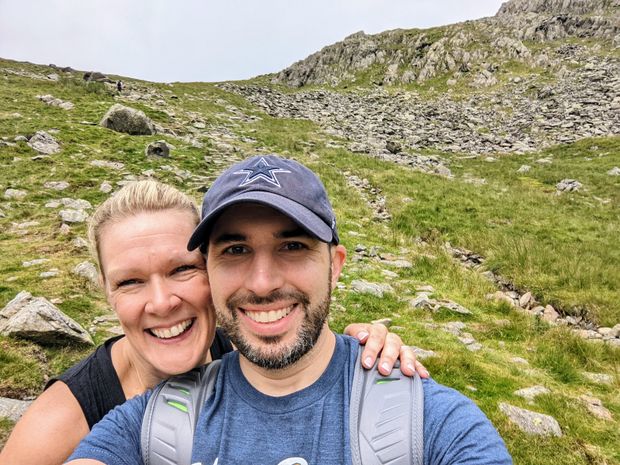
Is working out with your spouse or romantic partner a good idea? In this episode, Alex is joined by his wife Abbie to discuss how working out with your partner can both improve the relationship and help you reach your fitness goals…as long as you set some ground rules. If you’re thinking about starting a new exercise routine with your partner, Alex and Abbie have some tips for you based on their own experiences.
Read The Transcript
Alex: Welcome to Practically Fit, Real Fitness Over 40. I'm Alex Johnson. Jen Chamberlain is off again this week, attending her sister's wedding. So this week on the podcast, I'll be talking about working out with your spouse or romantic partner. Is it a good idea? Can it make your relationship stronger? Can it help motivate you to reach your fitness goals? And do spouses or romantic partners make the best fitness friends? But I'm not going to do this episode alone — in fact, who better to talk about this subject with me than my wife, Abbie? Abbie, welcome to the show.
Abbie: Thanks, Alex.
Alex: So, you've done some podcasts before — you work in HR. Doing a fitness podcast is a little different than doing an HR podcast.
Abbie: Yeah, I guess so, although it's still talking about something I'm very passionate about, so all good.
Alex: Today on the show, we'll answer the questions I mentioned at the top, plus share some of our practical tips for working out with your romantic partner or spouse. This is something we've had a lot of experience with over the past few years. For us, fitness is an important part of our lives, and honestly, one of the reasons why we fell in love. I think when we got together, we both had fitness as one of the top things we were looking for in a spouse — someone we could be active with, in whatever form that takes.
Abbie: Yeah, no, that's absolutely right. In fact, I think it was on both of our dating profiles — not only in the text, but in the photos too — and it was definitely one of the reasons we were attracted to each other and gelled so well together. Part of our early dating history was taking long walks together, going on bike rides, going hiking. So it's definitely woven through our relationship.
Alex: Yeah, and we also both had IPA on our dating profiles on Bumble.
The Research: How Exercising Together Affects Your Relationship
Alex: So let's talk about this topic — first, let's talk about what the research says. I want to start with how fitness might impact your overall relationship. I found an article on Psychology Today called "Why Couples Should Work Out Together." It cites a 2021 study from the Journal of Social and Personal Relationships titled, quote, "Better Together: The Impact of Exercising with a Romantic Partner." I actually wanted to read the source article from that journal, but the cost to access it was $437, which we run into from time to time on this show. So I'm grateful someone summarized it for me in the Psychology Today piece. This was a study of nearly 100 college students — so not quite in our age group, right, Abbie — but they exercised on a consistent basis with their romantic partners. Data was gathered through a survey, daily reports over two weeks, and interviews after the study was complete. Beyond asking about exercise habits, the researchers asked about mood and relationship satisfaction. The Psychology Today article summarizes it well: quote, "Exercising together with a romantic partner was associated with greater positive mood during exercise, beyond the happiness boost that results from the exercise itself, and correlated with higher positive mood during the day. Lastly, it was related to greater relationship satisfaction." So, Abbie, hearing this study, how do you feel about it? Have you noticed these things when we work out together — better moods, a happiness boost, a positive impact on our relationship?
Abbie: I absolutely think it does. Not only in terms of sharing that time together and doing something both active and engaging, but also in terms of being there to support one another — it's just a different way of supporting, and it gives a richness to things. I'm also impressed that there were 100 college students who had a romantic partner or spouse to even do a study on.
Alex: Yeah, I know, right? I found that kind of humorous too. And on the whole, I've noticed the same things you have — we'll get into this in our tips later, but sometimes there might be a momentary negative moment when you're working out together. On the whole, though, I find it to be a really important and meaningful part of our relationship — something I actually thought about when I was looking for a partner, that this might matter. And based on the experiment of our lives — not an official scientific study, but still — I think it has a massive impact on us day to day. So if you're asking my opinion beyond what the research says: yes, I think working out with your partner makes your relationship better, to a pretty large degree.
Abbie: Yeah, the other thing I'd say, which I think we've both experienced, is taking on something your partner does that you hadn't done before — it can feel less scary that way. For example, Alex lifts weights. I'd never done that in my life, so I started doing it, and having someone who's been there and done it, who I trust to walk me through it, makes a massive difference. And vice versa — I got Alex into trail running recently, something he hadn't done before. So I think it's really nice, because you can explore new things together and learn them together, and it weaves into your whole family life and the way you live. We spend a lot of time outdoors, we like being outdoors, and that weaves into weekends away, holidays, and so on. So it's just a different way of enriching the relationship across the board.
Alex: Yeah, and I think it's important too, because it puts you in situations where you're spending time together, which matters for couples. You get a lot of time if you're out on a run or a bike ride — even if it's a bit windy sometimes and we're yelling "what, I can't hear you" — it does give you time to talk. In a way, it can really enhance communication in your relationship too. So fitness is pretty great for enhancing a relationship. Now, you mentioned doing new things together, which is a nice segue to the next topic: can working out with your romantic partner help you reach your fitness goals? So, guess what — I found another study on this. This one dates all the way back to 1995, when I was still in my formative years. It's titled "Twelve-Month Adherence of Adults Who Joined a Fitness Program With a Spouse Versus Without a Spouse." This was a long-term, twelve-month study that set out to, quote, "determine adherence of apparently healthy adults who joined an exercise program with a spouse" — which they labeled "married pairs" — "versus without a spouse" — labeled "married singles." It was, quote, "hypothesized that married pairs would have significantly higher adherence than married singles, and that self-motivation would be associated with adherence." So basically, they took a group of married people who started a workout program — some as couples going together, the "married pairs," and others whose spouses weren't participating, the "married singles" — to see whether working out as a married pair would make you more likely to stick with the program. And guess what: married pairs had significantly higher attendance and a lower dropout rate than married singles, which appeared to be driven primarily by spousal support rather than self-motivation. In other words, the couples who worked out together stuck with it. Abbie, I think this is something we've noticed too — we keep each other motivated to work out even on days when maybe we don't feel like it.
Abbie: Absolutely. And I think it comes back to a couple of things you've talked about on the podcast before. One is that accountability-buddy effect — if the other person is relying on you, or expecting you to show up for a ride or a run, you're more likely to stick with it, and I think that's really true for us. The other is competitiveness. Alex and I can both be a little competitive, so the idea of him logging more miles than me, and me not keeping up, definitely spurs my competitive side. So there's a real balance across those different factors, and I see that playing out for us. And sometimes you just need someone to give you a little push, and who better than the person who knows you best?
Alex: Right. We even have our goals set in Strava, and if we're a mile off from hitting them, some of us will go out and do that one extra mile just to make sure we hit the goal. And by "some of us," I'm joking —
Abbie: He means him.
Alex: Yeah, we're both very competitive about reaching those goals. So that's something that works really well for us. So that's what the research says about working out with your romantic partner — it can improve the quality of your relationship, and it can help you reach your fitness goals. So how do you actually do this? What are the best ways to approach exercising together with your partner? I think this is especially relevant if you're starting a new fitness program with your romantic partner or spouse, or maybe haven't worked out together before — it's worth thinking through before you dive in. We've had our fair share of successes and a few pitfalls along the way, so we'll share some tips and some of our stories. Abbie, why don't you start us off?
Tip One: You Don't Have to Do the Same Activity, the Same Way
Abbie: Sure. First, I think you don't have to do the same activity together, or do it the same way. Going back to weight training — there's no way I can lift the same way Alex does. I can't lift as heavy as he does, and I haven't been doing it as long, so I don't have the same form. But I can work out at the same time as him, and in fact we do — we have an at-home gym in our garage, so we'll go out there, put on some music, and work out at the same time, even if we're doing different things. Maybe I'm doing an arms workout with dumbbells while he's doing seven thousand pull-ups or whatever he's up to. But it's still really great, because we're still working out together, and we really enjoy it — I've been known to dance around the garage between sets, just to amuse Alex. So you don't have to be doing exactly the same thing at exactly the same time; you still get that motivation boost and connection from working out together. It's the same with other activities — Alex can run a lot faster than I can, so I can't keep his pace if he's going at his fast pace, I wouldn't be able to hold stride with him. So a related, second tip: sometimes you do things separately. We might both go for a run on the same day but do it apart from each other, then cheer on each other's run, because my great pace isn't the same as Alex's great pace. One thing I've learned about myself — and this is where it helps to understand yourself — is that I struggle running with someone faster than me, because I try to keep up and end up burning myself out. I actually run a much better pace on my own than I do running with him. So it's okay to do those activities separately — just support and celebrate one another.
Alex: Yeah, those are great points. And you mentioned working out in the garage together — we love doing that, that's the great thing about having a home gym. This could update my newsletter post from a few months back, "18 Reasons to Have a Home Gym" — we could make it 19, because you can work out with your spouse in the comfort of your own home, dance in the garage, and not be embarrassed around gym weirdos. But also, along the same lines — you don't have to do the same activity, or do it the same way — you can go to the gym together if you belong to one or want to join one, because that can be very motivating for some people. One of you can hop on the treadmill while the other lifts weights — same concept at work.
Tip Two: Set Ground Rules
Abbie: The other tip we've talked about is, if you're going to work out together, maybe set some ground rules.
Alex: Yeah, I think this is an important one — our second tip. Setting ground rules can really matter, and this is one of the things I was referring to when I mentioned we've had a few pitfalls along the way. Ground rules for working out together — especially if you're doing the same activity side by side — are going to be unique to every couple. For us, I can give a few examples. Cycling is something we do together quite often, probably three times a week — we'll ride together in the evening or morning, when it's not too hot in Texas — and we have ground rules around that. One is that we won't leave each other behind. The one exception: Abbie knows me well enough to know I like to go up hills fast — that's part of what I like about cycling, the challenge of climbing. We did a ride yesterday with several big hills, and I'll go up at my own pace, but I always wait for her at the top. So if I'm feeling really good and want to chase a PR or a leaderboard time on Strava, we both know that about each other, and we set that ground rule ahead of time. We also set out who's directing the route — that's a more recent ground rule, because that's where we'd had some conflicts in the past. We're both pretty strong personalities.
Abbie: I'm a big route planner, whereas I think sometimes you like to just point your bike and see where it takes you. Life's an adventure.
Alex: So that could be a challenge, because in my head I've drawn out this whole map for where we're going, and if she wants to deviate from it — or I literally have the map loaded on my bike computer — it's caused a few conflicts in the past. So now when we start a ride, we're deliberate about it: okay, who's leading the route today? Are we following a map, or just going where the bike takes us? We had some repeated little friction over this the past couple of years, and since we started doing this, we haven't had that conflict anymore, which has been great.
Abbie: Yeah, especially with something like cycling or running — you do need somebody to lead the ride or the run, and then the other person follows their lead. For me, that's important; if you're both trying to lead, it just gets confusing. At least this way, we know who's in charge, and we can alternate that role between us. It also means we get some variety, because we'll each take the other on different routes than we'd pick for ourselves. It's nice to mix things up.
Alex: Yeah, so I'd really highlight this one for anyone considering working out together as a couple for the first time — set your ground rules, and again, they'll be unique to you. Think about things like pacing: will you stay together the whole time? If you're doing something outdoors, like a run, hike, or bike ride, or strength training, will you use the same weights? These things are worth setting out ahead of time, because it avoids conflict and keeps you in that happy place the study mentioned — where exercise contributes positively to your relationship rather than the opposite.
Tip Three: Listen to Your Partner, But Don't Hesitate to Push Them
Alex: One more tip, and this is the final one: listen to your partner, but also don't hesitate to push them. This one comes down to knowing your partner really well. You might be out doing some kind of exercise — cycling, running, whatever — and there's a day when you realize you need to back off on the effort or the distance, because your partner just doesn't have it that day. That happens to all of us; sometimes one of us feels a lot better than the other, and it's just a day to back off. But then sometimes, in this busy world with work and stress and everything else, you might have a day where you need that little extra bit of motivation — and that's where your partner can push you. This has happened to both of us. For example, on a bike ride a few months back, I remember not feeling great that day — probably from being on a screen all day at work — and I felt kind of disoriented when we headed out. About a mile in, I was thinking, I'm going to turn around, I'm going to go home — I was already in a pretty negative headspace. And you encouraged me in a positive way and kept me going. By the end of the ride, I actually felt so much better, both from doing the activity instead of being stuck indoors, and because I wouldn't have felt that way if you hadn't pushed me. So again, this comes down to knowing your partner, knowing their limits, and being able to judge whether they're genuinely not feeling well that day, or whether they just need that extra bit of motivation. Sometimes you can help them out by pushing them just that little bit, and it works out well for both of you in the end.
Abbie: I couldn't agree more. There are so many occasions where we've experienced this, and it really does come down to the person who knows you best — they can tell whether you're truly in a place where you can't push on, or whether you're just in a negative mindset and need to be encouraged along. I can think of a couple of examples. Not long ago we were out for a run, it was hot, and I really struggled in the heat — I was born in England, not exactly raised to run in these kinds of temperatures. But Alex pushed me to keep going, and we got to four miles. We were training for a race, so having that motivation to keep going mattered, and I felt great by the end. The other example: I introduced Alex to skiing, and we were out in Santa Fe, and he did not want to come down a run we'd gone up. I knew he could do it, I knew he'd be okay, but he'd put himself in this "I can't do it" mindset, looking down the mountain at the gradient. I remember from when I learned to ski, that's super scary — you look down and think, that's way too steep, I can't do it — and it's about breaking it down into segments. So I told him, I'm going to get you down this mountain, just follow me, trust me. I don't think anyone else could have done that with him in quite the same way — he trusts me, and he knew I wasn't going to put him in danger, that I'd get him down safely. I know he felt great by the time we reached the bottom — probably even better once we had an IPA in hand.
Alex: Yeah, that's a great example. And that's actually happened a couple of times now with skiing. The first time we went, I was still learning and Abbie's an experienced skier, and I actually quit on a lesson because the instructor had a very laissez-faire style of teaching, I'd call it — he took a bunch of us beginners up to a steeper run and they were all just bombing down without a care. I'm a pretty cautious person in some ways, and I just thought, I can't go down that. I literally quit the lesson, texted or called you from the slope, and you came and helped me get down. That was the first time. Then the second time, the one you mentioned in Santa Fe — I'd had a really good lesson that day and wanted to put it into action, so you took me up there, and it turned out to be a blue run, which for those of you who ski is the second level of difficulty — green is easiest, then blue, then black, and so on. I was pretty nervous about it, almost refusing to go down, and you're absolutely right — if it had been anyone else, I don't think they'd have gotten me down that slope. So yeah, that's a great example of how you can push your partner sometimes to motivate them in the realm of fitness.
Wrap-Up
Alex: So those are our tips on working out with a spouse. We hope you're able to put those into action, especially if you're starting a new workout program with your romantic partner. Talking through this today, I think we've learned a lot about how working out with a spouse can benefit both your fitness and your relationship — and that's what I think is so cool about it. Based on the research, spouses really can make the best fitness friends, and fitness can make a genuinely positive impact on your relationship. So I hope you've enjoyed the discussion today. Thanks, Abbie, for coming on the podcast on short notice and being a guest on the show — I really appreciate it. And I hope everyone enjoyed this episode. As always, head on over to practically.fit and check out our latest newsletter content — we've got some great stuff out there. Put in your email address and you'll get weekly content from both me and from Jen. You can also comment on the podcast and share your stories about working out with your loved one, your fitness friend, your spouse — you can do that right on the podcast page at practically.fit. And if you have questions or stories, feel free to email me at alex@practically.fit. Thanks for listening, as always, and until next time, remember: fitness is for everybody.