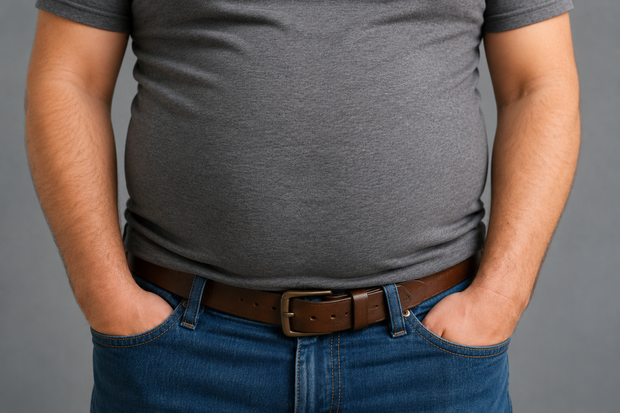
As I’ve reached my mid-40s, I’ve been battling a common foe: the “dad bod.” Abbie and I talk about our aging bodies all the time, and we thought this would be a relatable topic to tackle on the podcast.
Part of me thinks the dad bod is inevitable, but based on the research we did for this episode, that may not be the case. In fact, there’s evidence the choices you make as you age in your 40s, 50s and 60s can help you stave off the middle-aged bod.
We hope you’ll check out this episode of the podcast, where we dig into the latest research on metabolism and hormones, and talk about some of the biggest mistakes we make as we age that may contribute to that expanding midsection. And we’ve got practical tips on workout and lifestyle changes that can help keep you svelte.
Please leave a comment below, or shoot me an email at alex@practically.fit. We’d love to share your comment or question on the next episode of the podcast.
Read The Transcript
Alex: Welcome to Practically Fit, Real Fitness Over 40. I'm Alex.
Abbie: And I'm Abbie.
Alex: And today we're going to talk about why we gain weight as we age.
Abbie: So, some people call this "dad bod" — and I've also seen the term "mum bod" making the rounds too. So here are a few questions we'd like to cover today: Is this middle-aged mum or dad bod inevitable? Why, when you hit this age bracket, does weight gain suddenly go straight to your stomach? What are some of the biggest mistakes we're all making when trying to fight against this? And what can we do to slow down the weight gain?
Alex: That's right, Abbie. We took a deep dive into these questions, and did the research so you don't have to — you can just listen to the podcast. So let's talk about dad and mum bods. This is something I've been thinking about a lot lately, as I hit my mid-40s — I actually turned 45 this year. Over the past couple of years I've been starting to feel like I'm getting that classic middle-aged-man stomach, where no matter how much I work out, no matter what I do, it just feels inevitable. Even my own son jokes with me about it — "Oh, you've got a dad bod going now." I still feel fit, I still think I look pretty good, but there's just that creeping little stomach. I'll see myself on camera sometimes for work, or in photos, and think, "Oh, I've got to suck that in." We did a race here a few weeks ago, and I looked at the photos afterward and thought, gosh — I don't know if it was the running jersey or what, but I looked like I had the dad bod going.
Abbie: Although I looked at those photos and pointed out there was an amazing shot of Alex with "flying feet" — any runners out there will know that's the photo you want.
Alex: Yeah, well, I still feel like I've got a bit of the dad bod going as I hit 45. Abbie, this is something we talk about often, and kind of agonize over, but I do think it's a bit of an inevitable part of growing older, and there's only so much you can do about it.
Abbie: Yeah, I agree with that. I also think you have to be really careful not to compare yourself to your 20-year-old self, because you're just at a different time in your life — it's probably not terribly healthy to expect your body to look like it did when you naturally had a faster metabolism and were at a different point in life.
Alex: Yeah, and we exercise a lot — having a strong exercise routine is good — but there are other factors: diet, alcohol intake, sleep. These all play a role in weight gain as we age.
Is It Inevitable?
Abbie: And Alex mentioned a moment ago — is it inevitable? And if it is, what's to blame for it? It would seem that slowing metabolism would be the culprit, right? I just said we shouldn't compare ourselves to when we were 20 and our metabolism was different — but before we go on, let's make sure we're all clear on what we actually mean by "metabolism." It's everything that happens in your body to turn what you eat and drink into energy. If that slows down, will you gain weight? Well, actually, there seems to be disagreement about how much metabolism slows as we age. Traditional wisdom held that metabolism slows as we age. According to the National Institutes of Health, if you're an adult in the US, you can expect to gain between 10 and 25 pounds between your 20s and your 40s, and they say exercising and losing weight becomes more challenging, especially as you get into your 30s and 40s. However, there's a more recent study, published in the journal Science, showing that metabolism is actually pretty stable from age 20 to 60, and then slows about 1% per year after that. A lot of the analysis around this study suggests that other lifestyle factors may be more responsible for weight gain as we age.
Alex: Yeah, that's right. So, some mixed evidence there, but the newer study points to these lifestyle factors — so we can't necessarily point to the traditional idea that, "Oh, I turned 45, so my metabolism is slowing down." That may not actually be the case, based on some of this newer research.
Abbie: Or, if you're a woman — and I'm not disregarding the impact of perimenopause or menopause, I'm in that phase of life myself — it can be easy to think, "Oh, it's just menopausal weight gain, nothing I can do about it."
Alex: Right. When I think about myself — I was a super skinny teenager, to the point where people used to make fun of how skinny I was, or say I had monkey arms, things like that. I really gained weight once I started strength training in college — that's when I first put on some weight. I was maybe 125 pounds going into college at 18, slowly gained weight through that period and through my 20s, and had been pretty stable in the mid-150s range. But just in the last few years, I'm up to about 165 — which is the weight I've always associated with my dad. I feel like he was always 165 pounds. So is that the slowing metabolism? Based on some of this research, maybe not — maybe it's other factors. But when we think about the research we just cited, maybe a dad bod or mum bod doesn't have to be completely inevitable, unless something else is at play.
There are also hormonal changes at play here. For men, the research shows declining testosterone is important — there are different estimates of how much testosterone declines over time, but generally studies show this starts around age 35. So if that's the average, I'm about 10 years into that right now. You mentioned menopause or perimenopause earlier, Abbie — for women, the hormonal changes involve declining progesterone and estrogen. Menopause definitely has an impact, but it's not necessarily the same experience for everyone — and we were chatting about this before the episode, that could honestly be an entire standalone episode on experiences around menopause. But the bottom line is that hormonal changes can decrease muscle mass, which can result in increased weight gain — and for men, that can start as early as age 35. Another thing I was curious about with dad bod and mum bod is: why does the weight gain go straight to your stomach?
So I did some further digging into this, and found a study from 2014 — I thought it would have all the answers. Just for context: the fat around your organs — a lot of what may be responsible for that weight gain in your stomach, what used to be called a "beer gut" — that's called visceral fat. Important distinction: visceral fat is the fat around your organs. So I read this study thinking it would have all the answers, but alas, it said, and I quote, "Little is known concerning the reasons for this shift." The study cites multiple factors, including the hormonal changes I mentioned. But it's not good to have increasing visceral fat around your stomach and organs — that visceral fat increases your risk of disease. So this weight gain around our midsection, while natural, isn't the best thing in the world.
Common Mistakes: Diet and Alcohol
Abbie: Yeah, absolutely. So — what are some of the mistakes we're making when trying to fight against this? And what can we do to slow the weight gain? A few things stand out to me when I think about mistakes we're making in our 40s and 50s — and I deeply resonate with a lot of these. The first is, on top of not comparing ourselves to our 20-year-old bodies, we also, unfortunately, can't do the same things we did in our 20s.
Alex: That's right — like, when I was younger, I could eat a ton of stuff, burn it off, and be fine.
Abbie: So we can't eat and drink like we did in our 20s and 30s. You can still build those things into your diet, but you have to be so much more intentional, and think about the trade-offs.
Alex: Yeah, I feel like this is something we've been trying to get better at lately. We both love food — food is a source of enjoyment for us, we like going out and trying different restaurants, trying new things. There's a bit of a bad habit in our house with DoorDash. My favorite food in the world, hands down, is a hamburger. In my mind, I have to have a hamburger once a week — it's one of my joys in life. Sometimes it's a fancy hamburger from a nicer place, sometimes it's just from the burger joint down the street. But I want to have my hamburger. I like nachos, I like pizza — I don't have these things every day, but I want to enjoy them. I think this is something we struggle with, especially being busy with work and everything else.
Abbie: Yeah, no, absolutely. One of my guilty pleasures is chocolate — I love a bit of chocolate every day, but now it has to be a small piece, not a whole bar. I also love chips — or crisps, as we call them. But like Alex says, I think you just have to start being much more intentional, and build those things into your plan rather than just mindlessly eating.
Alex: Yeah, I went through a period in my late 20s where I was really bad about fast food. I was working an earlier schedule at that point in my career, so I'd get home around 3 or 4 p.m., and I'd just be tired from getting up early for work, and my exercise habits weren't great during that stretch. There was a period where I was eating Taco Bell — or whatever drive-through burger place — pretty frequently throughout the week. Honestly, that's what eventually pushed me into much better shape, and I haven't stopped since. About six months before I turned 30, something just flipped, and I thought, I'm eating poorly, I'm not exercising enough, I've got to do something. I'd gotten up to a similar weight to where I am now, and dropped it — though obviously I wasn't middle-aged at that point. These are things you battle throughout your life. I mentioned DoorDash earlier — we go through these periods where we say, "we're not doing that anymore."
Abbie: No — it was a New Year's resolution last year, and I think it lasted about a month.
Alex: Yeah, and then it slowly builds back up again — it's easy, especially with teenage kids.
Abbie: Teenage kids, yeah.
Alex: And that could be a whole other subject — the nutritional habits of teenage kids in 2026. But it can be challenging when it comes to the lure of food. I think this stuff starts to show up in your yearly wellness checks at some point — Abbie could probably tell you I hate doing my yearly doctor's appointment and blood tests. She's very nonchalant about hers.
Abbie: It's not that I'm nonchalant — I just think of it as data. It's there whether you check it or not, so why wouldn't you rather know it than not?
Alex: Right. I go through this thing every year where I do the blood tests, and then for a day or two I'm stressing out about the results — especially cholesterol. That's where I'm seeing it now, in my mid-40s — for me it's hereditary, my dad had high cholesterol, so I'm right on the edge. I work out a ton, but this is the kind of stuff — the eating — that just starts to show up in those blood tests around this age. I've been having conversations with people now about their cholesterol levels, which is about the most "I'm in my mid-40s" thing ever. I think the other big one is alcohol, right, Abbie?
Abbie: Yeah, no, definitely. I think there's been a real shift over the last few years — I actually saw something the other day asking whether we're in the period where we're seeing the same kind of shift for alcohol that we saw for cigarettes. Because when we were growing up, it was just such an embedded part of society — you could argue it still is — but there's so much more research now about the damaging effects of alcohol, that it's a Class 1 carcinogen. I think more and more people are becoming conscious of the impact it can have on your body.
Alex: Yeah, and maybe these younger folks who aren't drinking are onto something. Speaking of that — one of the most interesting studies I saw while researching this was on metabolism, out of Stanford University in the past couple of years. The headline was "Massive Biomolecular Shifts Occur in Our 40s and 60s." What this study showed about your 40s was that, quote, "significant changes were seen in the number of molecules related to alcohol, caffeine, and lipid metabolism, cardiovascular disease, and skin and muscle." So the molecules in our body are changing drastically in our mid-40s. The study's author, Michael Snyder, said that the changes to alcohol metabolism in your mid-40s, quote, "result from an uptick in alcohol consumption in people's mid-40s, often a stressful period of life." I thought that was interesting — this uptick in alcohol consumption in people's mid-40s.
Abbie: Yeah, that is interesting. I always associate higher alcohol consumption with people in their earlier years, their 20s, so that's really interesting. The other thing I wonder is — as your body is changing and aging, is it just so much harder for it to process alcohol? It's a toxin, and your body has to process it out. So maybe there's something in that. I know for myself — we're not huge drinkers — but I've noticed that even one glass of wine hits me very differently now, especially the next day, compared to when I was younger.
Alex: Yeah, same thing for me. I had a day recently where — I'll usually have one whiskey, sometimes two, but if I have three whiskeys —
Abbie: He had three the other day, watching the soccer.
Alex: Yeah, that's not a great scenario. I feel like I'm recovering from that for two days straight. So I also wonder about this uptick in alcohol consumption in people's mid-40s — you mentioned people drinking more at younger ages. I think a lot of younger people do the binge-drinking thing on weekends — certainly when we were younger, I don't know about you, but I knew people who drank every night, though not many. I just wonder if, in the mid-40s, since they attribute it to a stressful period of life, maybe people are drinking a moderate amount every night instead — something like that. Maybe we need to rethink that nightcap to wind down, or that thing where "I'll just have one whiskey" turns into two, because I know I'm often guilty of that. So overall, aside from alcohol, diet becomes more important in your 40s — that's something a lot of us face. There's never a bad time to make dietary changes — you don't have to wait for a New Year's resolution, like we did with the DoorDash thing, since that, predictably, didn't work out for us. It's also always a good time to get a wellness check. I was joking earlier about how much I don't like going to the doctor for mine, but when I was younger I didn't do it at all — around age 30 I started, and haven't looked back. That's something that's really important for folks.
Abbie: Oh yeah, I completely agree. I grew up in England — you didn't really have a "wellness check" there, it wasn't even something that was an option, as far as I know. I've been out of England for 10 years now, so maybe that's changed — if any of our listeners are in the UK, feel free to drop a comment and let us know. But in my experience, that wasn't something you had. I actually love that part of the American health system — there are plenty of parts of it I don't love, but that one I think is really powerful, because, as I said, it gives you data and insight you can act on. A couple of years ago, my wellness check showed my vitamin D was slightly low — now I know that, and I can do something about it. I think that preventative approach is such an important part of looking after yourself — it's so much more effective than having to react to something after the fact. So yeah, completely agree on the wellness check. I also think about making small changes — sometimes we go all-or-nothing on these things, but if you just make small adjustments to your diet — like Alex loves a hamburger, so don't say, "I'm never eating a hamburger again," just don't eat one four times a week.
Alex: Right — eat it once a week.
Abbie: Yeah, once a week — or build it into your routine, because that becomes sustainable. For me, at least, the minute I start being really restrictive, it's just not healthy — it doesn't work for me.
Exercise: Rethinking Cardio and Strength
Abbie: So, a second thing we wanted to explore is exercise, and using it to combat weight gain. For me, what used to work when I was younger no longer works the same way. I was a real cardio bunny for years — running, HIIT, Zumba — remember when Zumba came out on the Wii? I loved that. But that over-reliance on cardio just doesn't work the same way as you get older. I still love cardio, I'm not giving up running, but I've come to look at it differently over time, in terms of the type of cardio I'm doing. There was an interesting detail in that visceral-fat study Alex mentioned earlier — again, that's the fat around your midsection and organs that's really the hallmark of a mum or dad bod. It suggested you can prevent some of that shift in fat distribution to your midsection, even into your 60s and 70s, if weight gain is prevented and activity levels are kept high. But when it talks about "activity levels," the study points specifically to strength training and high-intensity interval training. So, thinking about the types of exercise we're doing — instead of relying solely on running, cycling, or walking, it's about mixing in strength training, and thinking about how to alternate your runs, doing some easy and steady, and others with intervals built in. I think we've really seen this shift, Alex, in how we've approached our workout schedule. For years I would just go out and run as fast as I could, every single run.
Alex: Yeah, I've been known to do that too. But with running lately, again, it's about not over-relying on steady-state or Zone 2 cardio — which is important — but mixing in intervals. Sometimes we go to the track to do workouts, though we haven't done that as much over the summer — but we do speed work in our running. I've been doing a lot of speed work and tempo runs early in the morning, shorter distances. And strength training is just critical — I try to change things up from time to time. Right now I've really been enjoying calisthenics and more challenging calisthenics movements, and that's given me really great strength gains over the past six months or so. And you've been incorporating a lot more strength training into your routine too.
Abbie: Yeah, no, definitely. Everything I've read — and I'm sure any women listening who are over 40 will relate — you can't get away from strength training and protein these days, those two things seem to be coming at us hard and fast. But everything I've read has focused on how to build strength, and I've been thinking about it not just from the perspective of, how does this help me today — how does it support my running goals, my fitness goals — but also longevity. I want to be mobile as I get older. All of those strength-training exercises are the ones that keep you fit and healthy long into life, so you can get up and down off the sofa by yourself, still climb the stairs when you're older. It's really a key part of fitness for the rest of your life. The other thing I really like about strength training is that you can get some high intensity into it too — I did a workout yesterday with back-to-back supersets, and your heart rate really does climb when you're doing those. Or, Alex went through a stage a couple of years ago where he was obsessed with kettlebell swings.
Alex: Yeah, you can do a lot of HIIT-style training with kettlebells — there are a lot of different ways to work interval training into your workouts. If you don't like cardio, or intense cardio, you can get it through weights too.
So — we've talked about a couple of big mistakes people make when it comes to dad bod: eating like you're still in your 20s once you hit your 40s and 50s, we talked about alcohol, we talked about over-relying on steady-state cardio. I think another big mistake is not getting enough sleep. I looked into this, and there's plenty of evidence that not getting enough sleep is linked to weight gain — and again, this comes back to hormones. The research I found here was pretty complicated, but to put it simply: if you're getting less than seven hours of sleep a night, your hormones are altered, and feelings of hunger can increase. So sleeping less can mean your body signals that it's hungry more often. As we get into our 40s and 50s, like we mentioned, things can be stressful — maybe that's part of why people are drinking a bit more — but stress can also impact your sleep. You've got work — at this stage of life you're doing a lot with your career, it's your peak earning years, but at the same time there are financial pressures, kids — maybe your kids are at the age where they want a car, or they're heading to college — there's just a lot of financial considerations. Relationships can be challenging too, right? Not me and Abbie, we're amazing — but relationships in general can be challenging. There's a lot going on during this stage of life, and it can affect your sleep. So working out a good bedtime routine, and making changes to improve your sleep, is critical. Some of the advice out there: limit alcohol before bed, as we talked about, and don't eat too much right before bed either.
Sleep and Recovery
Abbie: Yeah, we were guilty of this one, because — like Alex said — you're at such a busy stage of life. You've got work, so you don't finish till six, then the kids need things, activities or appointments or whatever, and we'd find ourselves not even starting dinner until 7:30 or 8 p.m. I'd also been used to eating dinner later — that was just part of how I grew up. But we also went to bed late — my parents were late-to-bed people, so it was fine to eat dinner at 7 if you were going to bed at midnight. But we're trying to get into bed around 10 or 10:30, so if you're eating at 9, that's not ideal.
Alex: Or this happens too — when you go out to eat and have a big meal. Even the other night, we went out and had kind of a big meal, and I didn't sleep as well.
Abbie: Yeah, but that's also because that big meal was served to us in about 38 minutes flat.
Alex: Yeah, that's true. I'm not sure why restaurants always want to rush you through.
Abbie: It's a very American thing.
Alex: So those are a couple of things that can help your bedtime routine. The other thing cited for sleeping well is avoiding blue light — phones, tablets, or TVs right before bed. Not sure how we score on that one all the time.
Abbie: You know exactly how we score on that one all the time.
Alex: I enjoy watching TV occasionally before bed. Abbie likes to look at her phone sometimes.
Abbie: Alex is the biggest TV addict I know.
Alex: Yeah, so those are some of the things out there. I find I sleep better if I do some yoga-type stretching about 30 minutes to an hour before bed. And reading, obviously — I love reading, and I've noticed on the nights we read before bed, I typically sleep better. Maybe you get a nice cup of tea — there are so many relaxing teas out there now. The traditional one is Sleepytime tea, which has chamomile in it — there are also teas with valerian that help with sleep, or other relaxing blends.
Abbie: Or a nice bath, with lavender or some other kind of salts in it — I find I sleep really well after I've had a relaxing bath.
Alex: Yeah. So sometimes we'll have that drink before bed, or a big meal, but it's really about limiting those nights and trying to make the most of your sleep. So bottom line: incorporating more intentional diet into your life, building strength and interval training into your workouts, and getting enough sleep are the key factors we found in our research for combating the dad or mom bod. So there you go.
Wrap-Up
Abbie: Yeah — and one other quick thing: I think what's made a real difference for us, along with the wellness-check data we talked about, is having our Garmin watches tell us our sleep score. I think that keeps you informed — and to your earlier point, Alex, about trying to limit it — if I've had a night where my sleep's been disrupted, and I can see it on my watch, that makes me more conscious about not letting it happen a second or third night in a row.
Alex: I hope everybody enjoyed the episode. We'd love to hear your thoughts on any other tips you might have for combating the dad or mom bod. Feel free to leave a comment on the episode or shoot us an email at alex@practically.fit, and we'll share your story and insights on a future episode.
Abbie: That's right. And if you enjoyed this episode, please leave us a rating and review on your favorite podcast platform. Next week's episode of Season Two is going to focus on AI and fitness — Alex and I are really excited about this one, it's something we've been tinkering with for the past year or so. We'll talk about our experiences using AI in our fitness and workouts, which is obviously a hot topic right now, since AI is the hot topic across everything. So stay tuned for that episode. And remember — when it comes to fitness, you don't have to be perfect, you just have to be practical. We'll see you in the next one.